Nicole Wiebusch (67)


Rally is a fun activity that is an excellent introduction to other dog sports. Dog sports are not only a fantastic way to bond with your furry friend but also to engage their minds and bodies in meaningful activities. Among the various dog sports available, rally stands out as an excellent introductory sport for several compelling reasons. Whether you're new to dog sports, looking for something fun to do with your dog, or trying to expand your dog's skills, rally can pave the way for a rewarding journey into other disciplines.

For many dogs, stillness is a challenging concept to grasp. Especially in sports-bred dogs, which are highly motivated by movement, training methods often focus on encouraging and rewarding action. As a result, teaching stay behaviors can be more difficult. However, introducing the concept of stillness can help your dog remain calm, composed, and focused in various situations, benefiting high-energy or anxious dogs in particular.
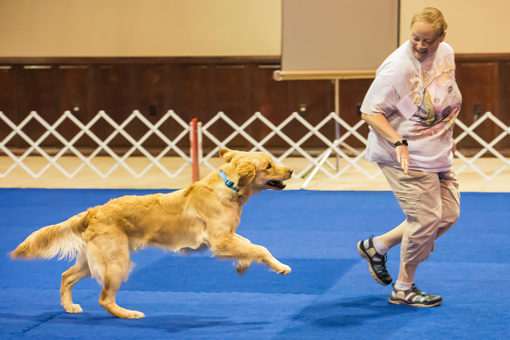
Often times, the hardest step in heeling is that first one. There are so many fun ways to start moving forward! Stop heeling from a boring sit and start motivating your dog!

In AKC (American Kennel Club) rally, each sign that requires you to walk around your dog also includes a pause when you get back to heel position. So, what exactly is a pause?
A pause is a complete stop of forward motion with your feet together. Pauses can be fairly quick, but it should be obvious that you paused in heel position. I recommend counting to two in your head to ensure that there's no question about your pause.
Forgetting to pause after walking around your dog is one of the more common handler errors in AKC rally. Unfortunately, it's a big error that will cost you and your dog 10 points for an incorrectly performed sign. It's an easy thing to forget as you are rushing through the course!
Let's look at the signs that require you to pause in heel!

Chin rests are useful for so many things! It's one of my favorite behaviors to teach. I use chin rests for obedience behaviors, such as teaching a close front and getting a quiet hold, but it's also useful for cooperative care, consent, and start button behaviors. In addition, chin rests help the dog be still, so it's helpful to settle the dog and lower arousal.

Position changes are a skill needed in both rally and obedience. Taking the time to teach a good foundation will make the more advanced position changes much easier. In this blog, I'm working with Excel, who wasn't quite two when I videoed these sessions.
Excel is a dog who finds movement very reinforcing, and therefore, stillness is difficult. For this reason, I spend a lot of time reinforcing him for doing nothing. This helps with anticipation and also helps him keep his body quiet and still. If your dog is like Excel, reinforce for waiting for the next cue and stillness even more than you reward the movement behaviors.

Why is it that dogs often disconnect after reinforcement? Have you ever noticed that your dog checks out after he or she has received a reward? This is a pretty common problem, and it can be exhausting to keep your dog in the game. So, why do dogs disconnect after reinforcement?

Teaching your dog advanced commands can be a rewarding experience, and one valuable skill for rally is lateral movement in front of you. This blog post will explore a training approach involving mats or props to guide your dog through this challenging but achievable behavior.

Dogs like us, dogs can experience frustration when they are not part of the action. This is commonly referred to as FOMO (fear of missing out).

Rally is a fun and captivating dog sport that requires not only obedience skills but also excellent memory recall abilities. Not only do you as a handler need to remember how to properly execute the signs, but remembering the rally course is essential for seamless performance and achieving top scores. In this blog post, we will explore practical strategies to help you improve your memory and successfully remember rally courses. Let's dive in and unleash your memory power!

Mastering side steps in rally can be a source of immense joy for both the participant and the audience. While teaching a proficient side step may pose some challenges, the effort invested is worthwhile.

Staying in heel position is a fundamental behavior in rally and obedience training. To ensure your dog maintains heel position throughout a course, building value and enthusiasm for being in that position is essential. In this blog post, we'll explore engaging games to increase your dog's excitement and success by finding and staying in the heel position. You'll enjoy happier and more successful performances by teaching your dog these games!

Generalization is a crucial aspect of dog training that enables dogs to apply learned behaviors in various situations. When teaching a new behavior, the environment and cues significantly shape the dog's response. However, if the cues are too closely associated with specific contexts, the dog may need help generalizing the behavior. In this blog post, we will explore the concept of generalization and provide practical tips on teaching dogs to respond to cues regardless of the environment or contextual cues.

Is precision important to you in rally or obedience? It's true, most of us would like our dogs to be precise and accurate! Sometimes, however, the way we go about achieving that goal of precise behaviors can affect the dog's attitude. So how can we get both precise behaviors and happy dogs?

Location specific reinforcement cues are extremely helpful for improving position while heeling. Because where you deliver the treats affects where the dog wants to be, you can use that to your advantage for whatever tendencies your dog might have.
Reinforcement cues tell the dog that he or she is right. Location-specific reinforcement cues take that a step farther by delivering the reward in a specific way or area, therefore affecting how the dog might perform the behavior in future repetitions. Because dogs are very efficient creatures, they will quickly figure out how to most effectively get the treat. Therefore, they tend to gravitate towards where the treat comes from. If we can be strategic about reward placement, we can affect the tendencies of the dog over time.
Let's look at some common location-specific reward markers in heeling.

You're in the middle of a rally run, and something goes wrong. Your dog makes an unexpected mistake, and you're left frantically wondering what to do! Making those split decisions in the moment can be hard, but those decisions can make the difference between a qualifying and non-qualifying run! Let's talk about the best way to handle some of the more common mistakes that happen in the rally ring!

Why would you want to use props to teach front? Because, used PROPerly, they can make your life a lot easier! Keep reading to find out why I love using props to teach fronts!
In my opinion, it's easier to fade a prop than it is to fade extraneous body movements and cues. Trying to show your dog where "front" is with treats and your hands isn't easy!

Have you heard of the 3 D's of dog training? It's a pretty popular term that many trainers use. The 3 D's refer to Distraction, Duration, and Distance. These are one way to categorize the difficulties or challenges in dog training.
Distraction refers to both the environment and things in the environment that are distracting. Generalization (moving to a new environment to help your dog learn the behavior more thoroughly in all settings) is a form of distraction.
Duration is how long the dog is performing the behavior. It can also refer to the number of reps of a behavior, or even how many behaviors are chained together at one time.
Distance can mean a couple of different things. Distance between the dog and the handler is one part. The other is distance from a distraction(s). The farther the dog is away from a distraction, the easier it will be for the dog to perform behaviors.
If you think of Distraction, Duration, and Distance as challenges, it's easy to remember that you should only increase one at a time. However in practice, people often try to increase the challenges too quickly, or increase two or even all of them at the same time. In order for your dog to be successful, you want to be sure that two out of three are as close to baseline as possible.

Many dogs struggle with the handler walking around the dog during a stay exercise. The key to success for stays is to break it down! Stay training consists of slowly and carefully increasing difficulty to ensure success.
When you first start stays, you want to make sure you are really splitting, meaning you are breaking down the behavior into tiny little pieces. At first I don't move my feet at all. I make sure I get some duration on the behavior before I start moving. When I do start moving I just start with weight shifts, rocking back and forth on each foot.
Then I'll take a tiny step.

The more ways we can incorporate fun moves into heeling, the more enjoyment our dogs get out of it! I love teaching the dog to spin in heel! I use the left spin all the time. Admittedly, I'm not nearly as fond of the right spin and only teach that one for the rally master class.