Best in Class: Conformation Show Skills and Conditioning
Have you ever watched a breed ring dog show and thought, “That looks easy! It’s just walking in left handed circles and standing still”? Well, my friends....there’s actually a lot more to showing a dog successfully. In this class, you’ll learn the specialized skills that make a confident, polished handler: proper handler mechanics, techniques for teaching your dog how to show, and conditioning exercises designed specifically for the breed ring.
Course Details
Have you ever watched a breed ring dog show and thought, “That looks easy! It’s just walking in left handed circles and standing still”? Well, my friends....there’s actually a lot more to showing a dog successfully. In this class, you’ll learn the specialized skills that make a confident, polished handler: proper handler mechanics, techniques for teaching your dog how to show, and conditioning exercises designed specifically for the breed ring.
This class is ideal for anyone who wants to show their dog with confidence while improving their dog’s strength, posture, and overall presence in the ring. You’ll leave with practical, step-by-step strategies to handle your dog with ease, along with a tailored conditioning plan designed to build muscle, improve posture, and help your dog truly stand out.
Teaching Approach
Learning happens best with clear structure, consistent expectations, and a step-by-step approach that builds skills intentionally. With years of university-level teaching experience, I bring research-informed methods and thoughtful lesson design to every class. My goal is to help handlers understand not just what to do, but why it works, so they can raise confident, capable dogs who move intentionally and perform their best in sports, the show ring, or everyday life.
In this class, handlers are guided step by step in learning the skills needed to show their dogs confidently in the breed ring. Each week includes lectures with videos and images to bring the concepts to life, covering handler mechanics, teaching your dog how to show, and exercises to strengthen your dog’s muscles and improve posture. Homework follows a consistent, progressive structure, building foundational skills before adding more advanced techniques.
Students enrolled in working Gold spots receive personalized guidance through a combination of voice-over video reviews and written feedback. This approach allows each team to get targeted, practical support while also giving auditors the chance to learn by observing the coaching process and applying those insights to their own training.
Syllabus
Week 1
• Terminology
• Understanding your specific breed standard and how important this is.
• Stacking “Balanced Stands”
o What is stacking?
o What does a stacked dog look like?
Do’s and don’ts
o How do we teach our dogs to stack?
Hand stacking
Free stacking (we will talk about this later in the class on teaching it)
• Equipment
o Stacking boxes (purchased or homemade will give DIY instructions)
o Inflatable equipment (pieces you will need)
Week 2
• Anatomy & angulation knowledge
• Continue working on stacking our dogs.
• Equipment and how to use it.
o Leads
o Collars
• Conditioning exercises for teaching a “stacked” stand.
o The do’s and don’ts
Week 3
• Target training for the ring
• Conditioning exercises
o for pulling over their front
o Strengthening dog’s topline
• Introducing inflatable equipment and how to use it.
Week 4
• Form and Function
• All about gaiting your dog.
• What is gaiting?
• How do we teach it?
• What should it look like?
o If there is a table or ramp in the ring, what do you do?
• Conditioning exercises to support gaiting.
o Cavaletti poles for the breed ring
• Train your dog to move ahead of you in a straight line in the ring.
Week 5
• Total body conditioning exercises for a strong stand and movement in the ring
o Exercises to target the front, core and rear and how to advance them for your dog specifically.
Week 6
• All about the judge’s exam
• Showing the dog’s bite
• How to support your dog in the ring during the exam
• What is the judge looking for and feeling for and how can you make your dog feel their best to the judge.
Prerequisites & Supplies
Equipment needed.
• Wooden Blocks or a stacking box
o I will give DIY instructions on building your own in week 1.
• Fit bone or propel inflatable or flexiness stacking bars.
• Foam pad
o I will demonstrate how to use the fitpaws wedge inflatable but it’s not a required piece of equipment.
• Yoga mat (a thick one in which you can cut up and some tape)
• A pivot disc.
o A paver, a bowl with non-slip placed on top of it, something stable that won’t move with your dog putting weight on it.
• A wardrobe (long) mirror is useful.
• A tripod to video your sessions.
Sample Lecture
How the judge sees your dog. See image below. Here you have nailed the perfect stack for your dog in the ring. Things are going amazing! BUT do you know how to properly present your dog in a manner that will support your dog’s structure while the judge goes over (examines) your dog? To fully understand this, we must know what the judge is “feeling” for.
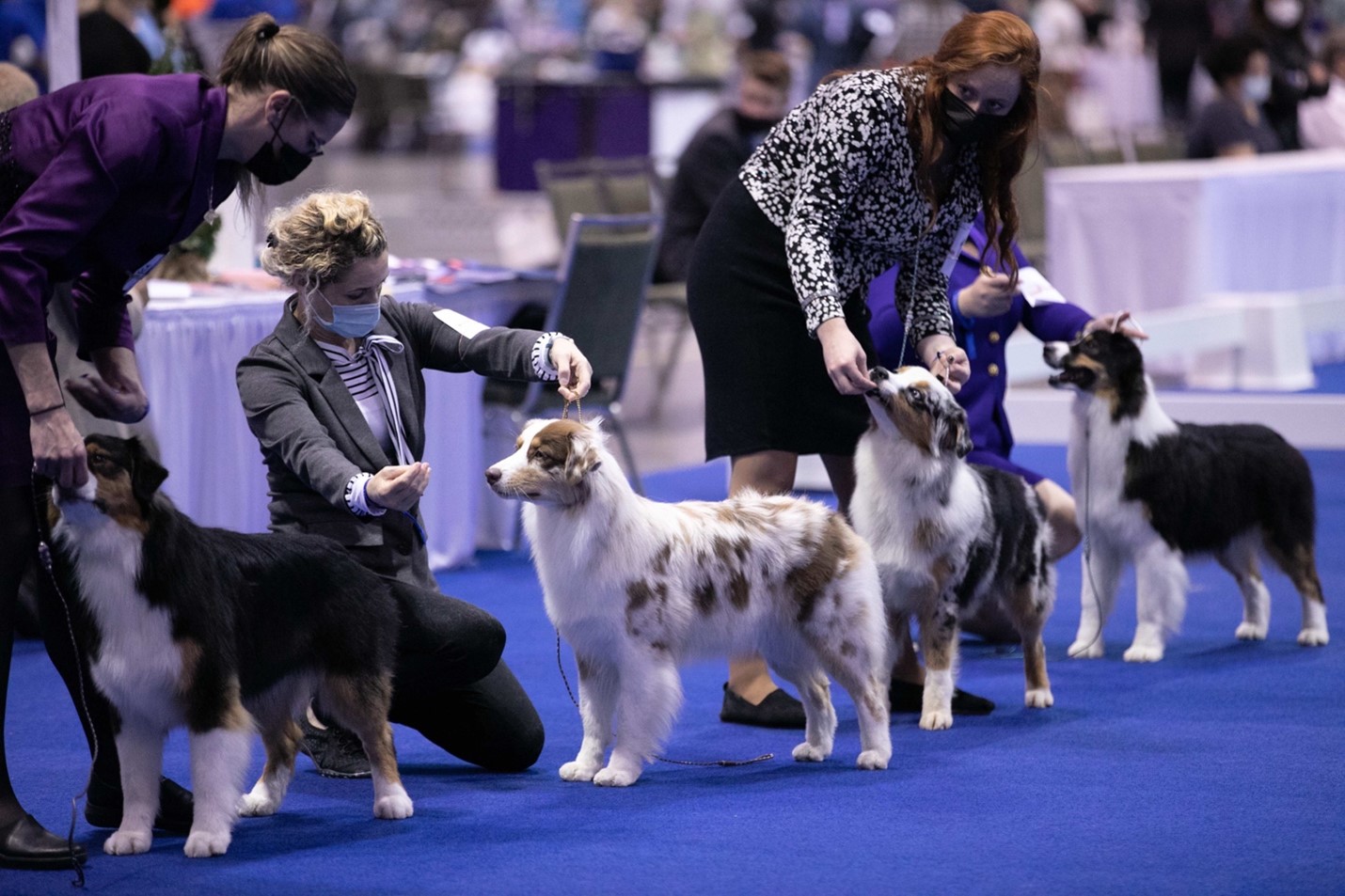
What the judge is feeling when they “go over” (examine) your dog. See image below.
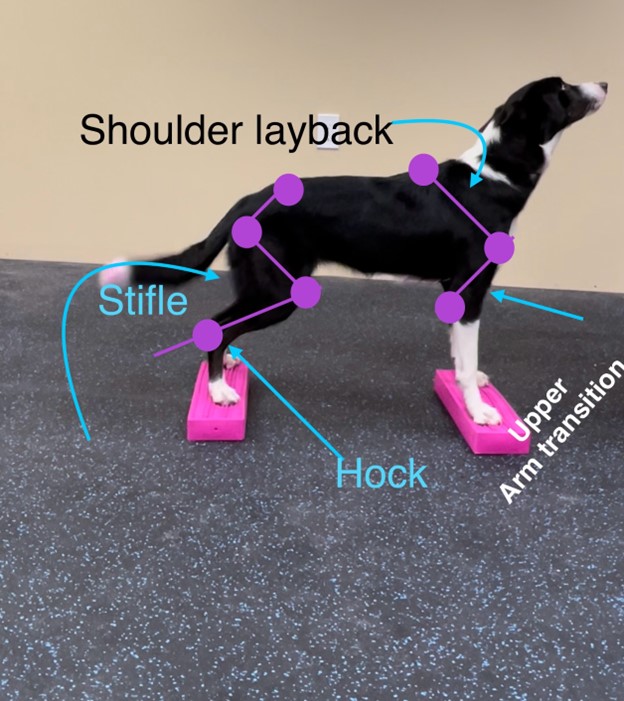
What is the judge feeling for during their exam? The above picture outlines what they are looking and feeling for and explains why their hands are placed where they are during the judge’s exam.
How can you make sure the judge feels what they are needed to on your dog? With a proper stack!
The stack is the most important component of dog showing.
It provides the judge with the outline of your dog.
The outline paints the picture of “type” along with overall conformation. Remember it matters.
The stack can have multiple different looks depending on your style of showing.
The stack will make your dog feel good to a judge or it will not.
The stack will affect how your dog’s structure feels to the judge as they are examining.
We don’t want to stack our dogs poorly as it can render the dog with more movement. Think about a dog wiggling around or sinking into their structure. We have all seen it or experienced it.
Now consider if you have stacked your dog properly, the dog is standing with balance and intention in their stance. This dog will feel better to the judge.
Your ability to control your dog’s head during the exam can make a nervous or make them confident in examining your dog.
Why does the head position and control matter?
The head being under complete control controls the dog and the spine of the dog. We want the spine of the dog to be straight. Maintains stillness in your dog’s body.
DON’T: stack your dog then step away leaving your dog to undergo the judge’s exam alone.
DO: support your dog during the judge’s exam.
Instructors
Ashley Escobar (she/her) has been training dogs and their people for over 20 years. She is a retired college professor of mathematics with a masters of mathematics and also holds a master’s degree in veterinary science, with advanced veterinary coursework and a background in clinical canine rehabilitation also studying animal biomechanincs. ..(Click here for full bio and to view Ashley's upcoming courses)...
Registration
Gold
$260
Enrollment limit: 12
- Access to all lectures and homework forums discussion
- Read all posted questions and answers
- Watch all posted videos
- Post general questions to discussion forum
- Submit written assignments
- Post dog specific questions
- Post videos (unlimited)
- Receive instructor feedback
Registration dates:
January 22, 2026 - February 15, 2026
Silver
$130
Enrollment limit: 25
- Access to all lectures and homework forums discussion
- Read all posted questions and answers
- Watch all posted videos
- Post general questions to discussion forum
- Post dog specific questions (video only)
- Post videos (up to 2)
- Receive instructor feedback
Registration dates:
January 22, 2026 - February 15, 2026
Bronze
$65
Enrollment limit: Unlimited
- Access to all lectures and homework forums discussion
- Read all posted questions and answers
- Watch all posted videos
Registration dates:
January 22, 2026 - February 15, 2026
Scholarship available! Apply here
Why choose us?
We offer a variety of online training solutions designed to help you and your furry friend achieve success

FAQ
Explore the questions we get asked most often and find out everything you need for a smooth experience with us.
Start by clicking on the Course Schedule link at the top of this page. If registration is open, select the course you wish to take from the list and click on that link. From that page, click on the registration link and choose the enrollment level you are interested in. This webpage describes the steps in more detail.
Registration opens on the 22nd of the month preceding the course start date (ie March 22 for courses beginning April 1st) and close on the 15th day of the month the session has started (ie April 15 for courses starting April 1st). You cannot register for 6 week courses outside of this period.
Scholarships are offered to students who do not feel they can afford the full tuition, but who have a sincere interest in expanding their skills as a dog sport trainer. Scholarships are offered in the form of a 50% tuition credit at the Bronze level. To apply, select the Scholarships link from the top menu (under new students) or click this link. We ask that if you are on a scholarship, you limit yourself to one class. There are a maximum of three scholarships per student permitted in a calendar year.
Our testimonials
Don't just take our word for it — see what our clients say about their experience working with us.