OB630 Shaping a Fast and Furious Retrieve
Want a strong, motivated retrieve of the dumbell and a good foundation for utility exercises? Join me as I teach you how to create a firm hold, the end skill in the complex retrieve chain. Our basic goal is a dog who thinks that holding skill is the best part of the whole thing, and hurries to get there when we ask for a retrieve. Importantly, we'll also be covering how to create a dog that starts the action and demands the opportunity to hold the dumbell, a crucial part of achieving total "buy in" from your learner dog. Teaching a hold is hard and sometimes we as handlers need that information from our dogs.
Course Details
Want a strong, motivated retrieve of the dumbell and a good foundation for utility exercises? Join me as I teach you how to create a firm hold, the end skill in the complex retrieve chain. Our basic goal is a dog who thinks that holding skill is the best part of the whole thing, and hurries to get there when we ask for a retrieve. Importantly, we'll also be covering how to create a dog that starts the action and demands the opportunity to hold the dumbell, a crucial part of achieving total "buy in" from your learner dog. Teaching a hold is hard and sometimes we as handlers need that information from our dogs.
This class is for creating a formal retrieve, not for retrieving toys. (that information can be found in the toy class!) Dogs are expected to be strongly motivated by either food or to have the basic toy skills (bringing back to drop or tug, and dropping toy on ground as well as shaping witin the toy game concepts) if the handler wants to use toy skills as a reinforcement.
We will spend some time on refining both food and toy reinforcements, figuring out what is the most exciting for teaching this hard behavior.
Other skills needed:
- chin rest
- fronts-or almost a front, sit on a platform can be considered good enough.
Teaching Approach:
Bullet points, lecture and short videos outlining each step. Printed steps, minimal talking in the actual videos.
Syllabus
Progression:
- Switch
- Grab
- Hold with chin cue
- Hold for toy
- Proofing hold with toy or food
- Moving hold/coming into front
- Coming into front from angles
- Pickup fast
- Come back fast
- Pickup moving into front
- Various pickup angles
- Stay in basic position while object is thrown
- Speed to the dumbbell
- Putting the chain together
Prerequisites & Supplies
FE130 Toys Class
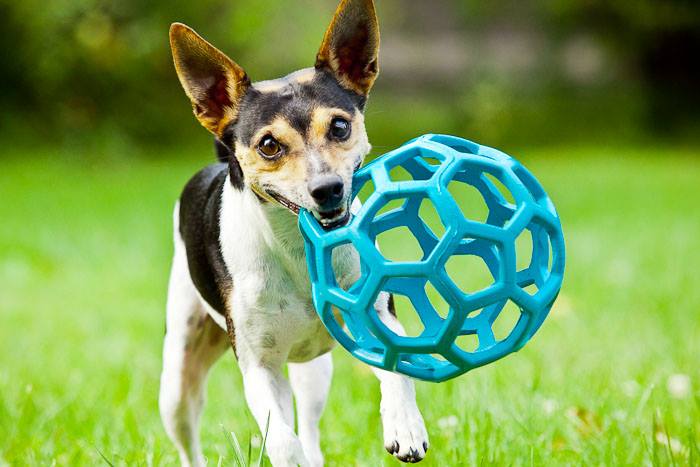
Do you have a dog that chases the ball, yet won’t bring it back? Plays keep away with toys? Tugs but won’t let go? Bites you instead of the tug? Obsesses over toys, yet won’t listen to a single thing you say? Is your dog so high in drive for toys that they can’t think? Or do you just want to channel that prey drive right from the beginning and add the attitude your dog has for tugging or chasing toys to the obedience or agility ring?
Sample Lecture
Hold step 2: Combining grab and chin rest
Basics needed:
- Chin rest
- Grab
- Treat reward or Switch
Steps:
- Grab with light 2 finger pressure still holding object by ends (to get the dog used to feeling something under his chin)
- Grab with chin cue and 6 fingers under chin, holding the object by the ends with thumbs and forefingers
- Get 2 seconds of duration at this step
- Grab with finger pressure under chin letting go of object with thumbs and forefingers free
- Grab with initial finger pressure under chin and removing fingers from under chin
- Testing the grip. If the grip slips at this point, you've got some choices. You can work on it by applying some rocking downwards and upwards pressure with your thumbs and marking when you feel the dog gripping harder to combat the pressure or you can go on to the next step, toy reinforcement and work on the testing grip with more exciting reinforcement. When you are "testing the grip" it should be subtle so that you can't see it, but can feel it.
We’re going to use the chin rest to up your chances of getting calm holding rather than chewing.
I usually use food as a reward for this step, but if the dog needs a toy reward to encourage grasping harder, I don’t hesitate to switch to a ball or tug. At this point, I will always be playing with Switch in between each 5 repetition set to encourage arousal and hard gripping even if still shaping with food reward.
I let my dog offer a couple grabs, and then I put the holding object under my arm and ask for a couple chin rests, rewarding each grab and each chin rest.
Then I present the object again, holding it at each end with my thumb and first finger, and letting the other 3 fingers of each hand fan out underneath. When the dog grabs, I quickly bring my fingers up to touch the dog’s chin, and then just as quickly, cue the marker word. You are trying to get the dog used to the pressure of fingers under his chin while grabbing the object and get him through any initial startle response he may have. Most of the time I only touch 2 fingers initially, and then a couple repetitions later (assuming all is going well), stick all 3 fingers of each hand under the dog’s chin.
If you think it may help, you can use your chin verbal cue as well.
I then alternate chin rest without object, and chin rest with object until I get a Freeze type behavior on the chin rest with object repetition, the same freeze that you get with the plain chin rest.
Here are Rachel and Pele showing an excellent progression of grab, then chin rest, and then combining the two:
Their next step would be getting a 2 second duration "freeze" behavior before removing any thumbs or fingers.
Here are Debbie and Sarek showing this:
Once I get the freeze with the object in the dog's mouth and full chin rest under his chin, I start to remove my thumbs from either end. At this point, I can also stop alternating with the plain chin rest. If at any time, the grip softens or the dog starts to chew, I can go back to holding the magazine with my thumbs.
Here is Manchita and Stacey working through this step. Manchita is a Mexican Hairless, otherwise known as a Xoloitzcuintle. Here they are starting to remove her thumbs from the holding of the magazine. Notice how she still keeps her fingers under Manchita's chin with full chin rest.
When the dog is comfortable at this step, I would start to remove my "chin fingers" one by one.
Testing the grip:
At some point in this process, most dogs normally starts to chew, or chomp, or let the magazine fall out of his mouth, etc... I have a couple things I try at this point.
Wait out the chomping. Often the dog chews, and then gives still mouth, chews, and then still mouth. if I make sure that I only mark when the mouth is still, often the chewing/chomping goes away on it's own as the dog learns the behavior that pays is still mouth.
Re present the magazine. If the mouth is moving, I can often just take the magazine out of the dog's mouth, wait for attention and then present the magazine again. I generally do not do this unless I have a 2 second freeze with full chin rest, and I've tried waiting out the behavior of chomping.
Communicate that harder gripping is wanted by very gently pushing with one of my thumbs in either an upwards or downwards pressure. When I feel the dog grip harder in opposition reflex, I mark and reinforce. The idea is not to set the dog up to fail, but to communicate that harder gripping is valuable. You can also pull gently towards you IF that does not make the dog go into tugging mode.
Here is Baylie and I working through some testing of the grip. Notice my easy repetitions among the hard ones:
Instructor
Shade Whitesel
Faculty
Shade Whitesel (she/her) has been training and competing in dog sports since she was a kid. Always interested in how dogs learn, she has successfully competed in IPO/schutzhund, AKC obedience and French Ring. Her retired dog, Reiki vom Aegis, IPO 3, FH 1, French Ring 1, CDX, was 5th at the...
Registration
Gold
$260
Enrollment limit: 12
- Access to all lectures and homework forums discussion
- Read all posted questions and answers
- Watch all posted videos
- Post general questions to discussion forum
- Submit written assignments
- Post dog specific questions
- Post videos (unlimited)
- Receive instructor feedback
Silver
$130
Enrollment limit: 25
- Access to all lectures and homework forums discussion
- Read all posted questions and answers
- Watch all posted videos
- Post general questions to discussion forum
- Post dog specific questions (video only)
- Post videos (up to 2)
- Receive instructor feedback
Bronze
$65
Enrollment limit: Unlimited
- Access to all lectures and homework forums discussion
- Read all posted questions and answers
- Watch all posted videos