OB335 Gloves and Go-Outs!

Do you dream of doing fancy obedience work someday?
Course Details
Do you dream of doing fancy obedience work someday?
No need to wait until you’ve slogged through novice! We can start splitting down the parts for even the most advanced exercises right from the start.
The go out is especially an exciting exercise to train as the dog gets to run and jump and there isn’t as much precision details to obsess over for the human. A huge win of starting this early on is that sending away from the handler is seen as fun, not stressful!
Both the go out and the glove exercise share the skill of “marking” or looking forward in the direction they are going to be sent. This foundation is what helps the dog find a straight line and avoid the other tempting choices like the other gloves on the directed retrieve or taking a jump on the go out send!
We can use different signals to help the dog know, before being sent, whether they are sending to a retrieve or to their go out spot. Too many dogs end up doing a go out to the corner where their glove was in the previous exercise!
There are no official prerequisites for this class! Dogs new to obedience are welcome to join as well as experienced competitors struggling to get their routines in a trial.
I have 6 core skills we will work on in this class for a choose-your-own-adventure training plan! The lecture "series" will be independent of the other series until the last stages so students can work on anywhere from 1 to 6(not recommended!) topics at a time.
1. Marking: teaching the dog to look ahead and find a "target" to send to. This will be a core foundation of both gloves and go outs as the dogs learn to find the straight line and ignore distractions.
2. Go out Touch: Teaching the dog a phsycal touch to the ring gates for the go out send. And the concepts of sending "between" /ignoring distractions on the send.
3. Go out Sit: Teaching a sit at a distance and applying that to interrupting a send behavior. (no "go out touch" needed to start this!)
4. Directed Jumping: Teaching the dog to send laterally to cones, then a jump. Find the correct jump even from a big angle.
5. Building Distance: The 1st lectures go over why dogs may struggle to send out and then we start looking at problem solving. Lecture 1 and 2 can be looked at with any stage of dog. Otherwise you will likely visit this series at some point in your "go out touch" journey.
6. Gloves: Working on a pivots, then a glove retrieve and hold. The dog should already have a formal dumbbell retrieve.
Teaching Approach:
Lectures may be all released at the start of this class for a "choose your own adventure" style class.
The lectures are broken down by each skill, often in multiple parts. I have written objectives and then written instructions for each step followed by multiple video examples for each step. The videos are usually between 30sec to 2min long and are taken from training sessions of a variety of dogs. I rarely use voiceover or subtitles in the video. At the end of each lecture is a homework summary with the steps quickly summarized in order.
Syllabus
We will break down all the skills needed for both the directed retrieve (gloves!) and the directed jumping (go outs!) exercises.
Marking Skills
will be used in both exercises and have the same foundation! They will start to differentiate in the last steps.
- Focus forward cues
- Default focus on handler until cued
- Duration of looking forward until released
- Holding the look forward even when the handler removes the signal
- Marking non-food targets
- Generalizing to different types of targets/objects
- Marking and ignoring distractions
- Marking with other choices
- Different mark signals for retrieves vs send aways
Go out Skills!
- Sending to targets at a distance, building motivation
- Touching a stanchion, gate, wall, or other barrier
- Increasing distance- and leave the food to get the food thoughts!
- Send straight- go between 2 cones, then 2 jumps
- Learning WHEN to take the cones/jumps
- Building even more distance
- Teaching a tight turn
- Teaching a fast sit
- Sit as an interruptor of the go out
- “Reverse send” back to the go out spot
- Directed cone/jump skills
- Finding the jump regardless of the angle
Glove Skills
- Pivot left and right
- A "dead" retrieve
- Glove retrieve
- (and all the marking skills from above!)
Prerequisites & Supplies
Sample Lecture
Go Out Touch 3: Sending Between
Goal
This lecture begins the concept of teaching your dog to always find the straight line on the send and ignore "distractions." This skill is usually started after a few weeks of teaching your dog how to send to their vertical target. You will want at least a 10ft send.
But wait!!! Don't click away if this is not yet your dog's skill level! Do you happen to have another target your dog knows how to send to at least 10ft like a platform, rear or front foot target? Any target your dog can send to and wait for you to deliver a treat will work to begin this concept!
Some of you may already have a nice "mark"/look forward cue your dog will do to their target, some of you will not have that yet. That's ok!!! The lectures may show examples of me marking the dogs, but I rarely wait until I have a mark to begin this concept of sending between things.
In this lecture will will use 2 cones as our distractions. These cones are stand ins for the jumps used in the final exercise! It is a small space friendly way to get started, and I like to introduce concepts without using the full formal picture so that mistakes are not made on the final version.
Introduction to Sending Between Cones
For this exercise, you will start at least 6ft away from the stanchion/target. You will have 2 cones directly off to your side, even with your start position. I want to have my cones at least 4ft from me (8t apart from each other). The further back you are from your target, the further apart the cones should be from each other.
Do not stand at the furthest distance your dog can send! You want the distance to feel relatively easy for dog as you add in this new difficulty of the cones.
Here is an example of starting this session with Ginny. The cones could be placed a little further away from me still!
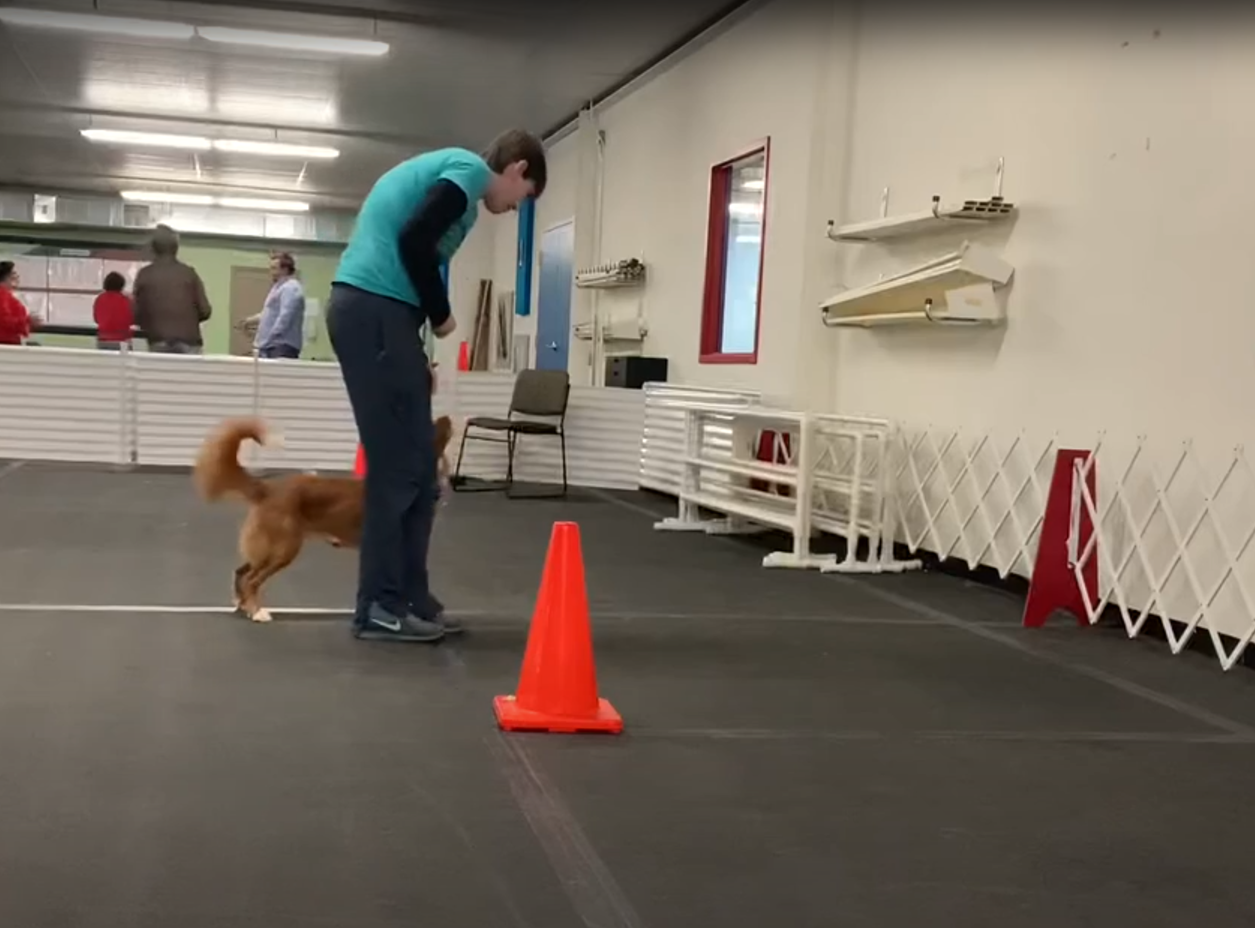
My goal is that the dog completely ignore the cones. I will NOT be sending to them at any point!
Send the dog to the target, walk up and feed like normal. Then cookie toss or lure the dog back to the start!
As the dog successfully moves between the 2 cones to send, you can move the cones further up so the dog has to move past them, or move yourself so you are starting at a further distance as long as the distance is still easy. I technically prefer to move the cones closer to thetargets than the dog further away, however I don't always take my own advice in these videos!
Here Ginny is working on this for the 1st time. Her send is not far, but I've added in the cones already! She makes it looked easy and I even move the cones in extra close to my line.
This is not Loot's 1st session, but I struggle to add distance without him taking the cones. I attempt to add speed into it and still remain close by starting from a cookie toss behind me. He takes the cone more than once even though I am standing close!
This is a pretty old video now and shows Zumi's early go out training! You will hear the "go touch" cue (which I did eventually change with her) and I am attempting to start further back. She makes some errors here but I reward even if she doesn't quite make it to the center. She also loves restrained sends!
Adding Distance / Cones Halfway
The next step of this is expanding what we just did. Can you start further away from the stanchion and send between cones off to your side? Can you get the cones gradually moving further up until they are at the halfway point of your send?
I work on "threading the needle" of teaching my dogs to run 2 cones that are pretty close even when I am pretty far back! I don't want it too tiny of a send to go between, but I do work up to doing a full distance send with my cones just 10ft apart from each other (5ft to the left and right of the center line). This is half the official distance of running between things- in a trial the 2 jumps will be 20ft apart/10ft off the center line.
This video with Ginny works on a halt distance send with her cones out. I am holding her collar as she marks and wait until she locks in. She knows this game from restrained send work! (Note you don't *need* a mark at this stage yet, but it can help if you are feeling stuck!)
Overview
Once you have a 10ft+ send to your go out spot (or any target!!), you can work on adding cones to the picture. Start even with the cones, and send to your target.
The dog does not take the cones at any time!
Reward at your go out spot! Then lure (or cookie toss away) the dog back to the start to do it again! As the dog looks confident in ignoring the cones, start to move the cones up, closer to the go out spot. Keep moving them forward until they are halfway between your start spot and the go out target.
The further away you are sending, the further apart the cones should be. I recommend having 5-10ft for the cones on each side of you (10 to 20ft apart) .
Instructors
Laura Waudby (she/they) trains and competes in obedience, rally, and agility. She was halfway to her OTCH with her UDX corgi, Lance, before his uexpected early retirement. She also has championship titles in USDAA and UKI. By day...
Registration
Gold
$260
Enrollment limit: 12
- Access to all lectures and homework forums discussion
- Read all posted questions and answers
- Watch all posted videos
- Post general questions to discussion forum
- Submit written assignments
- Post dog specific questions
- Post videos (unlimited)
- Receive instructor feedback
Registration dates:
May 22, 2026 - June 15, 2026
Silver
$130
Enrollment limit: 25
- Access to all lectures and homework forums discussion
- Read all posted questions and answers
- Watch all posted videos
- Post general questions to discussion forum
- Post dog specific questions (video only)
- Post videos (up to 2)
- Receive instructor feedback
Registration dates:
May 22, 2026 - June 15, 2026
Bronze
$65
Enrollment limit: Unlimited
- Access to all lectures and homework forums discussion
- Read all posted questions and answers
- Watch all posted videos
Registration dates:
May 22, 2026 - June 15, 2026
Why choose us?
We offer a variety of online training solutions designed to help you and your furry friend achieve success

FAQ
Explore the questions we get asked most often and find out everything you need for a smooth experience with us.
Start by clicking on the Course Schedule link at the top of this page. If registration is open, select the course you wish to take from the list and click on that link. From that page, click on the registration link and choose the enrollment level you are interested in. This webpage describes the steps in more detail.
Registration opens on the 22nd of the month preceding the course start date (ie March 22 for courses beginning April 1st) and close on the 15th day of the month the session has started (ie April 15 for courses starting April 1st). You cannot register for 6 week courses outside of this period.
Scholarships are offered to students who do not feel they can afford the full tuition, but who have a sincere interest in expanding their skills as a dog sport trainer. Scholarships are offered in the form of a 50% tuition credit at the Bronze level. To apply, select the Scholarships link from the top menu (under new students) or click this link. We ask that if you are on a scholarship, you limit yourself to one class. There are a maximum of three scholarships per student permitted in a calendar year.
Our testimonials
Don't just take our word for it — see what our clients say about their experience working with us.