OB118 TEAM Sports Foundations Level Two
Feeling stuck, intimidated, or overwhelmed working on obedience skills with your dog? If you feel like you’re not sure what to train, or if what worked for your last dog isn’t working for this dog, this class may be for you!
Course Details
Feeling stuck, intimidated, or overwhelmed working on obedience skills with your dog? If you feel like you’re not sure what to train, or if what worked for your last dog isn’t working for this dog, this class may be for you!
In the TEAM 2 class we provide structure as you build the skills your dog needs for TEAM, AKC, CKC, FCI, or the other obedience program of your choice! Let's break down the fancy skills you've seen in obedience trials!
In this class we introduce new skills while continuing to build the skills from TEAM 1:
- Retrieves
- Marking (look forward cue)
- Pivoting without a prop- left and right (the foundation for pretty heelwork!)
- Position changes in heel (and teaching a stand cue!)
- Scent articles
- Engagement-: "transitions" between exercises
- Sends to a target
- Jumping
- Stays with distractions
- Finishes
- Fronts (teach fancy front pivots to get that amazing lineup!)
Took the TEAM 1 class, but still working through the skills? That’s okay! Join us for TEAM 2 and we’ll continue to work together to get you unstuck and making progress.
The individual pieces of exercises are broken down for you in manageable steps. Introducing all these core areas from the start makes sure that obedience remains fun for both the dog and the handler!
Join us this term to take your and your dog’s obedience to a new level!
What is TEAM?
The TEAM titling program is a virtual program designed to help reward obedience trainers for breaking down their training and building a strong base of foundation behaviors.
Each level adds complexity for the dog-handler team, presenting them with a wide range of interesting skills to master right from the start. There’s no reason to hold back on training for distractions, distance work or the "fancy" skills while teaching your dog to heel!
Check out the full program on the TEAM website: https://www.fenziteamobedience.com/
Note: You do NOT need to be interested in TEAM titles or have taken the TEAM1 class to join! Many students use this class as a roadmap for AKC/CKC/etc. If you don’t have TEAM 1 in your library, it’s helpful to at least have
- Pivoting on a perch
- Position changes started in front of the handler
- Fronts with a platform
Teaching Approach
Lectures are released at the start of each week with all lectures released within the first 4 weeks. The lectures are broken down by each skill, often in multiple parts. I have written objectives and then written instructions for each step followed by multiple video examples for each step. The videos are usually between 30sec to 2min long and are taken from training sessions of a variety of dogs. I do not use voiceover or subtitles in the video. At the end of each lecture is a homework summary with the steps quickly summarized in order.
This class will have Teaching Assistants (TA) available in the Facebook discussion group to help the bronze and silver students! Directions for joining can be found in the classroom after you register.
Syllabus
Because of the wide range of skills, students are not expected to master all 10 skills. About 3 skills will be introduced per week and gold students will have the option of working on any of the skills discussed from the current week or previous weeks. All lectures will be released in the first 4 weeks of class in order to give students enough time to focus on their desired areas.
The skills taught will be:
- Retrieve: Beginning steps to picking it off the floor and delivery to hand. Teaching a hold!
- Fronts: Fading the prop, working on pivots in front
- Position Changes (sit, down, stand): Working in heel position, building in pauses, building greater distance, adding handler distractions
- Moving Engagement/ Social Play for working on "transitions" in the ring
- Pivoting Skills: Fading the perch with left pivots and starting pivoting to the right
- Finishes: 3 styles of finishes, fading props, proofing heel position
- Stay: duration, distance, distraction behind the dog, handler's back turned
- Jumping: taking a jump without handler movement
- Scent articles: Fading food lure in finding your scent, switching to a retrieve alert
- Mark: Teaching a cued look straight ahead, watch me vs look forward on cue
Release Schedule:
Week 1: Pivoting left and right in heel, Position changes (heel position and pauses), Marking, Send to Target
Week 2: Retrieve, Fronts, Position Changes (marching and distractions)
Week 3: Scent articles, Finishes, Position Changes (distance), Play/engagement
Week 4: Stays, Jumping
Remember each student can pick what they want to work on each week from any of the topics a lecture has been released on. Students will likely not be able to master all skills in the 6 weeks and will focus on topics they need the most guidance in.
Prerequisites & Supplies
Sample Lecture
Fronts Pt1: Beginning Front Pivots
Goal of the Exercise
A front is when the dog moves to sit directly in front of you. Both their head and their rear end should be lined up squarely with your belly button and your hands should be straight down at your side. In TEAM1 we worked on the dog getting used to the position by using a platform. The platform allowed us to have a high reward rate for the dog finding the perfect position and seeing our body position. If your platform was narrow enough it made it impossible for the dog to be wrong if they made all four feet on it.
Now in TEAM2, we need to teach the dog how to find front when the platform is gone. If you are lucky, your dog will naturally generalize the position in front of you and will find the center position even when the platform is gone. However, many dogs don't make this jump in logic!
Fading the Platform: Starting Front Pivots
Fading the front platform and keeping a confident dog who can line up straight is a common struggle. Many dogs learn that "front" means sit close to the handler, but they're not thinking of it as an actual position to aim for
The best success I've had in getting a dog to think about the position is to work on having them pivot in front of you. Unlike the platform, a perch structures the dog but still allows for errors. The dog needs to think a lot more!
Beginning Clockwise Pivots
We're going to focus on teaching the dog how to move clockwise before we officially start "fronts." From your heelwork training, the dog knows how to rotate counterclockwise, but you may not have spent much time going clockwise before!
Make sure your toes are pointed towards your perch. With your toes facing the perch it is impossible for your dog to get into a proper heel position!
If possible, try to have your dog nibble on some treats while you step to get your toes facing the perch so that your dog is facing you, not at your side. Give them several treats just for being there and not moving to try and get into heel.
Then try and step to your left around the perch, with toes still facing in, to encourage the dog to move clockwise. Reward any effort!!!
We don't want to get all the way to their rear end and directly push into them. If your dog is struggling to move, try being further away from the perch so you can be slightly behind them instead of at their side.
Here Freya Cat is starting this exercise. You can see how she really wants to rotate counterclockwise! I am attempting to move myself back to "front-ish" position after feeding her if I get too far into her space. But you can see how I then try standing further away from the perch so that I'm applying some pressure but not touching her:
Front-Ish Goals!
When your dog can move clockwise and counterclockwise on the perch, we're going to tighten up their position in front of us.
Because most dogs still really want to try to get into heel, at least 75% of your rotations might be done clockwise!
Your first big goal is to loosely get the dog back in front of you on the perch and keep them there! Feed several times for the dog being in front of you by either lowering both your hands down to feed at the center of your body, or slightly turning their head in one direction to try to gently move the dog a little bit closer to straight.
Rotate a quarter turn only after already giving the dog several cookies in a row for stillness!!
Bring both of your hands together as you feed and present the treat in the center of your body. This helps to prevent the dog from leaning to the side that has the treats!
Here with Wren I demonstrate how frequently I want you to feed in front!!!! Focus on position over motion. Note that her position isn't perfect and that's ok. I will shape for straightness once I'm certain she's not going to be a "windshield wiper" and offer motion back and forth when I'm standing still. In this video we're starting to get to the step where I could feed, take my hands back to my side (my formal front picture!), and then quickly feed again!!!
And here Freya Cat is at this stage of thinking more "front" thoughts. She under rotates more going clockwise and I try to move myself to be straight as I feed. I spend way more reps going clockwise than counterclockwise because it's the harder direction!
In the video above with Freya, I'm giving her extra help with my hands in front of my legs because she's a cat. You can start out with this help if your dog is really prone to surging past you, but try not to give this hand help for very long.
A great way to start fading hand help is to rotate-feed-then hands to your side for a small pause before feeding again! You can do a few cycles of hands to side-feed- hand to side- feed before rotating again. This will show your dog what the final picture looks like!
Here is Aero's first lesson on front pivots. I primarily go counter-clockwise as she really wants to suck into heel! I try to feed multiple times in front, but I can't get my hands to my side quite yet for their "home base" and instead rapidly feed and put them back to my stomach. At the 1:30 mark I attempt a little bit of going clockwise towards heel and quickly catch her with my cookies to prevent over rotation.
Arlo is also new to front pivots and really wants to offer going to my side. I'm doing a lot of work on stillness with my zen hands out. Tons of hands to side-feed- hands to side-feed! I do some cookie toss breaks here but he's not really ready for finding front so I try to catch him with a treat as soon as he's stepping up on the perch.
Catch Up Fronts
At this next stage, your dog should be pivoting pretty well with you in front-ish position as you move quarter turns around the perch. Now we want them to start pivoting to find front without the help of your movement. To do this I play a "catch up" game where I either have the dog stay while I rotate a quarter turn and then release, OR I have the dog nibble on a cookie as I rotate a quarter turn (dog doesn't move), then release the cookie and let the dog catch up to me to find front.
Here I'm working on this game with Kiwi.
Arlo is working this skill and he is really prone to over-rotating. I use my zen hand held out away from my body as a tiny bit of pressure to stop him in the direction he wants to rotate. This is a well known game that reminds him to focus on me, not the cookie, and thus he doesn't want to get too close to my hand. If he under rotates, I move away from him to help him go further. (You'll also see he's getting more advanced and I don't always help him when he's coming back from a cookie toss!)
Here I see that Mayhem consistently under rotates. Watch how as I feed her I start to rotate as I feed to get her straighter. I then do a quick hands to side-feed cycle in there to emphasize this position before doing the official catch up game where I have her nibble as I move.
Sophie the Poodle is doing a pretty nice job at this stage. Her handler is using a cue to "Front" but you don't need to do that at this stage unless your dog is really hesitant to move. Sophie offers wonderful stillness once she's in front and frequently is clicked for the duration instead of the rotation itself. That's a great next goal!
Fixing Crooked Fronts
When your dog is starting to get how to line up in the center of your body, you can use the pivoting to fix crooked fronts. Pivoting to face AWAY from the dog on a slightly crooked front can draw the dog's attention to what direction they were crooked.
In this drawing you will see the dog being crooked and then the handler moves to face away from the dog's butt so the dog has to rotate further to find it.
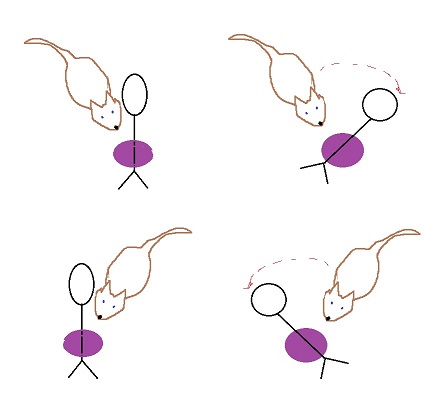
Here's a video demoing how to pivot around.
Problem Solving Pivot Fronts:
If your dog is struggling to rotate with you in one or both directions, I've had good luck in adding in a rear foot target for the dog to find! You can use anywhere from 1 to 3+ rear foot targets stationed around the perch, with the perch at the "center" of the clock. Make sure they are at a good distance for the dog to be able to have their front feet on the perch and their rear feet on one of the targets!!
You may wish to start with the dog rotating with you as you move before adding in the "catch up" front game.
Here Rye demonstrates this with a nice tall rear foot target. The height can draw attention to it, however the narrowness of the target does add some difficulty in having the dog confidently step up at a precise angle:
And here Enzo is working on it with nice lower rear foot targets. I like how when Enzo doesn't move all the way, he's verbally encouraged to keep moving so that silence doesn't mean try again:
Next Loot shows this technique, starting with the catch-up pivots and moving into the "find front" work (see the next section.) The cookie tosses to come into position are a bit harder as I do want the dog to step on with their front feet on the perch first and rotate vs stepping onto the rear foot target and walking forward onto the perch. I have better luck with this for Loot when I have just 1 RF target out (1.07) and use a slightly wider target:
Overview
1. Review Zen Games with a platform!! Teach your dog to line up straight even with tempting treats held low to the side or on the ground!
2. Start clockwise pivots on a perch!
3. Start front pivots on a perch!! Help them out with lots of cookies for stillness and have the goal of hands returning to your side between each treat (and likely feeding again before rotating).
3. Play the "catch up" game where the dog is already on the perch and waits while you rotate a quarter turn before you release them to find front.
Consider adding in a rear foot target to help them if they are struggling to line up.
Instructor

Laura Waudby
Faculty
Laura Waudby (she/they) trains and competes in obedience, rally, and agility. She was halfway to her OTCH with her UDX corgi, Lance, before his uexpected early retirement. She also has championship titles in USDAA and UKI. By day...
Registration
Gold
$260
Enrollment limit: 12
- Access to all lectures and homework forums discussion
- Read all posted questions and answers
- Watch all posted videos
- Post general questions to discussion forum
- Submit written assignments
- Post dog specific questions
- Post videos (unlimited)
- Receive instructor feedback
Silver
$130
Enrollment limit: 25
- Access to all lectures and homework forums discussion
- Read all posted questions and answers
- Watch all posted videos
- Post general questions to discussion forum
- Post dog specific questions (video only)
- Post videos (up to 2)
- Receive instructor feedback
Bronze
$65
Enrollment limit: Unlimited
- Access to all lectures and homework forums discussion
- Read all posted questions and answers
- Watch all posted videos