NW335 Nosework Handling: Insights and Improvements
Have you ever walked out of a search wondering whether your handling got in the way of a better performance?
Course Details
Is your handlng helping or getting in the way?
Have you ever walked out of a search wondering whether your handling got in the way of a better performance?
We've all been there.
Handling plays a much bigger role in Nosework than many of us realize. Without meaning to, we can create confusion through our movement, timing, leash management, body position, or the support we provide our dogs.
Seemingly small handling decisions can have a big impact on search performance. In this class, we'll identify common handling pitfalls and learn practical techniques to improve communication, build confidence, and strengthen your partnership.
We will also cover how to provide connection and support when a search starts to unravel. That's something we have to develop just as intentionally as our performance skills.
By the end of the class, you'll have a clearer understanding of your handling style and practical strategies to better support your dog throughout a search.
Suitable for teams of all experience levels, this course provides a supportive environment to refine your handling skills, develop greater consistency, and become a more effective Nosework team.
Join us to elevate your handling skills and unlock the full potential of your partnership—because the best handling techniques are the ones that make sense for both you and your dog.
Teaching Approach:
Lectures will be released at the start of each week so you can plan your week ahead. The lectures are designed to help a student understand the purpose of the exercise and how it might vary by team. Lectures with exercises will include a written portion, example videos, and homework. Any video lectures that include verbal information/instructions are accompanied with written steps. This class will involve some self-assessment and self-reflections on how your dog is responding to your handling. Gold students will have 6 minutes of video time each week. This class will work best for students who learn by reading text lectures, watching videos and who like having structured lesson plans.
This class will have a Teacher's Assistant (TA) available in the Facebook study group to help the Bronze and Silver students! Directions for joining that Facebook group will be in the classroom after you register.
Syllabus
This is a new class so the syllabus may change/adapt during the class.
Week 1:
- The big picture - more than a mindset
- Evolution of handling
- Handling Terminology and Video review of impacts
- Determining what makes sense to YOU
- Pace matching
Week 2:
- Managing input from multiple instructors/sources
- Handler's role vs Dog's Role
- Supporting the dogs role
- Mind Your Movements
- Building Odor-Driven Skills to Source Hides
- Working Through Unproductive Areas to Find Odor
- Building Value to Cast Off and Find Another!
Week 3:
- Search Flow Mechanics
- Mental Preparedness
- Start Line Tactics
- Leash Skills
- Managing False Alerts
- Handling handler focused dogs
- Handling environmentally distracted dogs
- Making Handler Suggestions
- The Finish Call and Happy Exit
Week 4:
- The 3 Ps (Being Present, Patient and Purposeful)
- How to maximize progress in known hide searches
- Handling during Vehicle searches
Week 5:
- Beware of proofing
- Being your dogs advocate
- Handling when going back to found hides
Week 6:
- Handling during container searches
- The art of coaching
- The art of competition
- Handlng in a No-Pee Zone
- Wrap-up
Prerequisites & Supplies
Sample Lecture
Lecture 1-2: Evolution of Handling
This is my personal journey of how handling has changed over the years. When we were starting out, we made a lot of mistakes. Some of it was nerves, lack of skills or not having a clear approach for handling our dogs. As we learned more about the sport, scent theory and how our body language affects our dogs, we started making changes and saw improvements.
Here’s what happened and what we learned:
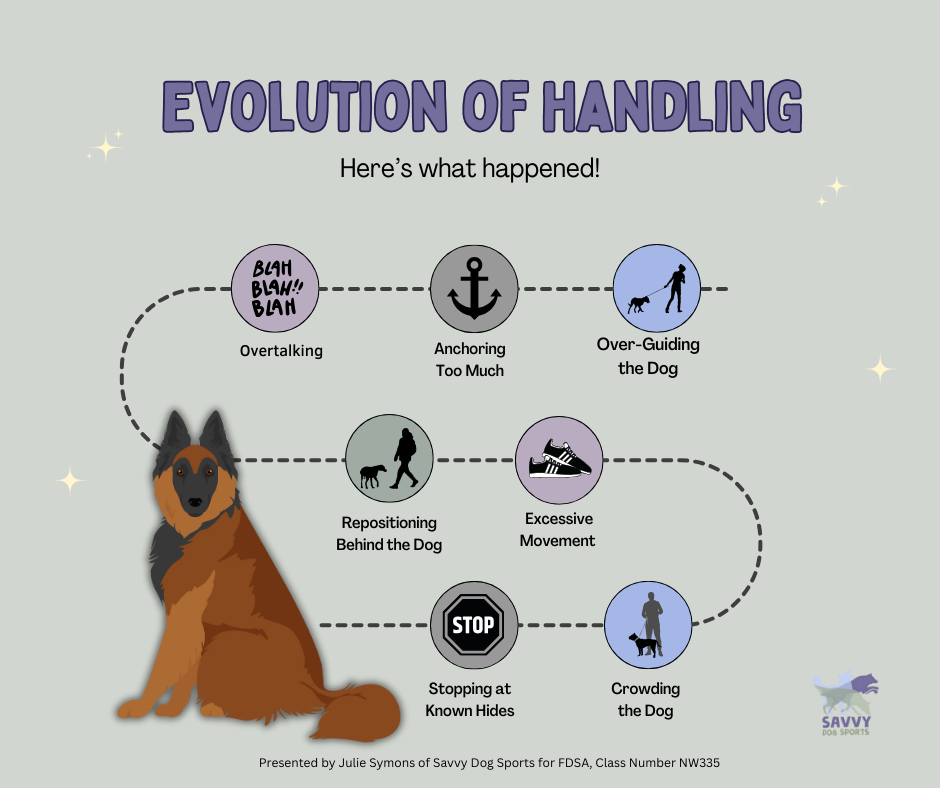
Losing Confidence
One recurring issue was how our handling choices undermined our trust in the dog—or theirs in us.
Stopping at Hides and Holding the Dog
- What we did: When we knew a hide was present, we prompted the dog to stop or held the dog near it.
- What happened: This made the dog believe we could help them find a hide, and when we couldn’t on blind searches, it often resulted in false alerts during trials.
- What we tried: To fix this, we kept moving or had dancing feet while our dogs worked odor.
- New problem: Our handling became noisy, and we acted unnaturally. When we tried to be “neutral,” we avoided hide areas entirely, disconnected from our dogs, and hesitated to follow them.
Moving Around Too Much
- What we did: We kept walking when the dog reached a hide to "proof" them and show that we didn’t "know" where the hide was.
- What happened: This created confusion, with dogs questioning their indications and thinking our movement was part of a test. If we didn’t trust them, they stopped trusting themselves!
- New problem: Our handling became noisy, and our attempts to proof turned into prompts for the dog to indicate.
Talking Too Much
- What we did: We got impatient and repeatedly cued “search” or “where is it” when the dog wasn’t finding a hide.
- What happened: This made our handling noisy and distracted the dog. They began looking to us for direction instead of working independently.
- New problem: Some dogs would only start working if they heard these cues or assumed they weren’t in a productive area.
Outcome: These handling choices created a cycle of mistrust, where both handler and dog lost confidence in each other, resulting in more false alerts and hesitation.
Disconnecting From the Dog
Another challenge was maintaining connection without over-controlling.
Anchoring Too Much
- What we did: We stayed still or moved out of the dog’s way to let them work independently.
- What happened: Disconnecting caused the dog to come back and check in, or lose confidence entirely. They struggled when we re-entered their space, creating a cycle of crowding and over-correcting our movement.
- What we tried: We re-entered the picture, but ended up crowding the dog, so we had to start backing up again.
Repositioning Behind the Dog
- What we did: We followed advice to stay behind the dog at all times. If they turned to face us, we moved to reposition behind them.
- What happened: This distracted the dog, broke their focus, and caused them to lose track of the search.
Outcome: We wasted time and energy redirecting the dog, which took their focus off the task.
Noisy Handling
Attempts to “help” often led to too much interference, causing more harm than good.
Crowding the Dog
- What we did: We stood too close to our dogs, giving us a feeling of control.
- What happened: Instead of helping, it encouraged over-reliance and false alerts.
- What we tried: Backing up, but this unintentionally became a signal for the dog that they were near a hide - even when they weren't!
Backing up
- What we did: We developed a bad habit of backing up - not only when we knew where hides were but also when we saw our dogs showing odor behavior. We even backed up when we were already far enough back!
- What happened: This consistent handling behavior started to become a prompt to the dog that they were at or near a hide. In some cases it could pull a dog off a hide as it influences a new direction.
Over-Guiding the Dog
- What we did: After finding a hide, we led the dog to the next area or stopped them from exploring “unproductive” zones.
- What happened: Dogs became dependent on our direction instead of independently searching for odor. As a result, we had to take on more handling to get better performance from them.
Outcome: Our handling distracted the dog, reducing their confidence and ability to work independently.
Key Takeaway
Handling is a balancing act. Small adjustments in how we support or guide our dogs can make a huge difference. The goal is to find the right balance between letting the dog work independently and providing the support they need. This class will look at the latest insights and improvements we can make with our handling to continue resolving the issues above. In the end, any approach you take needs to make sense to you and your team.
Instructors

Julie Symons
Faculty
Julie Symons (she/her) has been involved in dog sports for over 30 years. Starting with her mix, Dreyfus, in flyball, she went on to train and compete in conformation, agility, obedience, herding and tracking with her first Belgian tervuren, Rival. Rival was the first CH OTCH MACH Belgian...
Registration
Gold
$260
Enrollment limit: 12
- Access to all lectures and homework forums discussion
- Read all posted questions and answers
- Watch all posted videos
- Post general questions to discussion forum
- Submit written assignments
- Post dog specific questions
- Post videos (unlimited)
- Receive instructor feedback
Silver
$130
Enrollment limit: 25
- Access to all lectures and homework forums discussion
- Read all posted questions and answers
- Watch all posted videos
- Post general questions to discussion forum
- Post dog specific questions (video only)
- Post videos (up to 2)
- Receive instructor feedback
Bronze
$65
Enrollment limit: Unlimited
- Access to all lectures and homework forums discussion
- Read all posted questions and answers
- Watch all posted videos
Scholarship available! Apply here
Why choose us?
We offer a variety of online training solutions designed to help you and your furry friend achieve success

Our testimonials
Don't just take our word for it — see what our clients say about their experience working with us.
This class model has been so helpful, regardless of level of participation. I feel I learned so much from the lecture materials and the participants' videos/feedback. Feedback was specific and easy to follow. I can see so much change already in my and my dog's performance, and in our relationship. I can't wait for the next class!
Read all testimonialsThanks again for this opportunity and for the awesome timely feedback and encouragement you showed to all the posting students. Even though I was only at the bronze level I really felt like part of the class and feel that I got alot out of it. Kudos to you for the initiative!
Read all testimonialsA great course - so worthwhile for teams at all different levels. Even at bronze I found it to be fantastic. It felt like it was personal instruction for me - for both of my dogs, each very different. Taking courses from the Fenzi Academy gives you a chance to "work" with many different highly skilled/positive instructors and even today it isn't easy to find that many trainers who are primarily positive at competition levels. I feel like I come away with a new skills or insights from each class I take (4 so far).
Read all testimonials