FE240 Calling All Dogs
It is my passion to help humans and dogs develop stronger relationships based on games, shared adventures and maximizing our dogs' freedom while keeping them safe.
Course Details
It is my passion to help humans and dogs develop stronger relationships based on games, shared adventures and maximizing our dogs' freedom while keeping them safe.
A strong relationship and, built on it, a strong recall are two fundamental bricks of building the best possible life for you and your dog. That's what we'll do in this class!
This class starts from scratch - you can join right away, even if you only got your puppy or new dog yesterday. Gold spots will be tailored to you and your dog, your goals and the reinforcement strategies that work for you and your unique life circumstances.
Listen to the Fenzi dog sports podcast with Caden on building reinforcers & recall training and on free-roaming dogs as well as who this class is a good fit for.
Teaching Approach
Lectures will be released between 2 and 7 times a week. Instructions are provided in both written form (bullet points/steps) and via video examples.
Feedback is provided in written form and, when it makes sense, by means of time stamps.
My classroom is a safe space for whoever you and your dog happen to be. For Gold studets, my feedback is tailered to the team in front of me and their needs and goals, including time stamps on your videos (when time-stamping makes sense) and pointing you to resources and outside-the-box approaches. I approach training dogs as a collaboration between you (the dog's human) and me. You know your dog best, and I've worked with lots of different dogs and tried lots of different things - we both bring invaluable skills and knowledge to the table. Nerdy questions and challenges to my training steps are welcome, as are all kinds of tangents and side quests we happen to encounter along the way!
Please note that this class is a foundational recall class, not an advanced one.
This class will have a Teacher's Assistant (TA) available in the Facebook study group to help the Bronze and Silver students! Directions for joining that Facebook group will be in the classroom after you register.
Syllabus
Week 0
Syllabus
1.1 Training Basics: Marker Signals and Reinforcers (Rewards)
Week 1
1.2 A Philosophy of Recalls: Assessing Your Relationship
1.3 Who's your dog, and what do they like?
1.4 Long Line Basics
1.5 Extracurricular activities for dogs who’ll only work if they know you have a reinforcer
Week 2
2.1 Interactive Walks and Relationship-Building: Food Games
2.2 Interactive Walks and Relationship-Building: Fun with Body Awareness
2.3 Interactive Walks and Relationship-Building: Toy Games
Week 3
3.1 Introducing a New Recall Cue
3.1.1 Extracurricular activities for dogs who play keep away
3.2 Recall Games: A Theory of Setting your Dog up for Success
3.3 Recall Games: Let’s Play!
3.4 Multiplayer Recall Games
Week 4
4.1 Introducing Distractions: the Theory
4.2 Explaining the Rule Structure of the Distraction Game
4.3 The Long Line Stage
Week 5
4.4 The Barrier Stage
4.5 Off-Leash Recalls Away from Unprotected Distractions
Week 6
6.1 The Recall Ladder: from set-ups to real life
** Syllabus details are subject to change.
Prerequisites & Supplies
Sample Lecture
Lecture 5.1 The Recall Ladder: Raising Criteria in Real Life
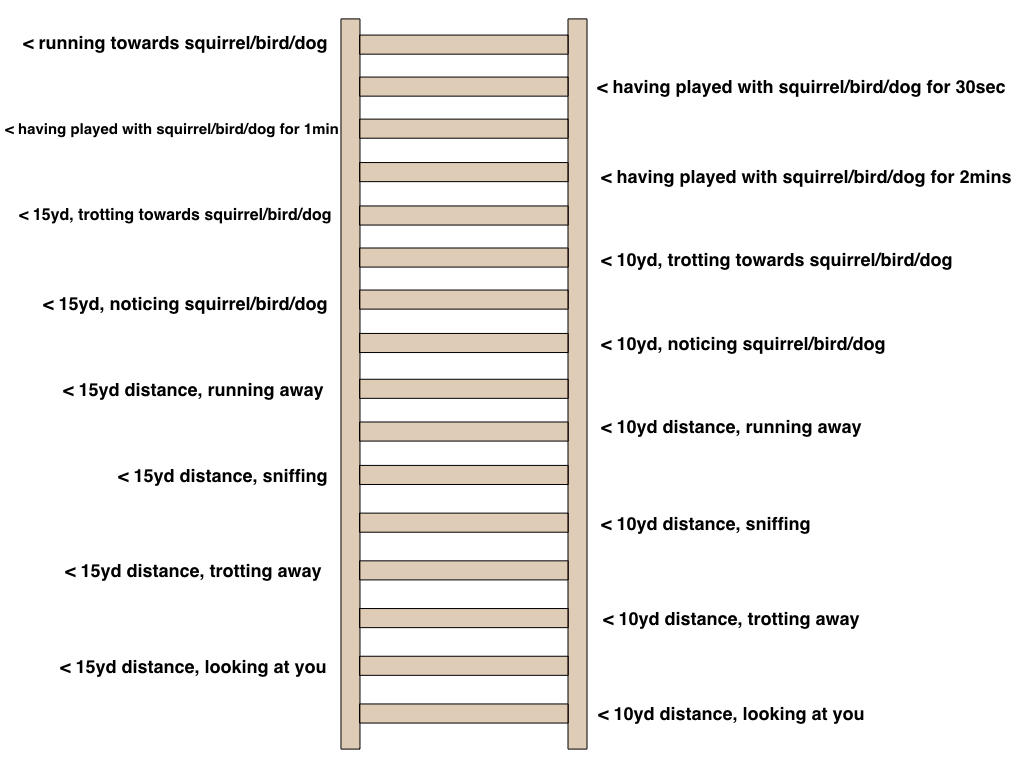
You have systematically introduced your dog to distractions in easy environments. By now, they should be able to come when called off various food and toy distractions in your house and yard or other easy locations. Congratulations! You are ready to start calling your dog in real life! In order to continue your excellent success rate, it is crucial that you raise criteria incrementally and keep in mind that ...
- the greater the distance between you and your dog, the more difficult the recall.
- when your dog is walking away from you, the recall is more difficult than when they are looking at you.
- the more distracted your dog (sniffing, playing ...), the more difficult the recall.
- the more challenging the environment (noises, people, other dogs, wildlife ...), the more difficult the recall.
- the less satiated your dog’s desire to explore, sniff, run and play, the more difficult the recall.
Examples
The video below was taken in my yard, but it is a good illustration for an important element of the lowest rung of the ladder: I wait until Grit has finished sniffing and lifts her head. Only then do I give the recall cue! This way, I can be certain that she is ready to receive the cue and respond correctly! I'm setting her up for success! The fifth rung of the ladder might look almost the same - with one big difference: I'd call while she was still sniffing.
Below is an example for the lowest rung on the ladder in an intermediate environment (short distance, all three dogs are looking at me):
Please excuse the shakiness and angle of the next two videos! Even though the quality isn’t great, I thought it better to include them anyways than to not share them with you at all.
An example for a rung on the upper third of the recall ladder: the dog is less than 10 yards away from me, but trotting towards the people and dogs in the distance:
Finally, an example for the highest rung of the ladder: Hadley has just started playing with the other dog, and I call him back right away. I treat and - this is VERY important, especially in the learning phase! - immediately send him back to play again.
Before you start working on the ladder,
adjust it to your dog! For example, whether they find birds, dogs or squirrels more distracting varies from one individual to the next. The easier a distraction, the lower it is on the ladder. It’s also possible that your dog’s ladder has a rung or two that are missing in my example, such as joggers, skateboards, wildlife, or cars! Think about it, and let me know how you are going to adjust the ladder for your dog in your homework thread.
Once you have customized your dog’s ladder, it’s time to start with the lowest rung. Stay at each rung until your dog has responded without hesitation five times in a row - then you are ready to move to the next rung! However, keep rewarding all lower rungs of the ladder as well, no matter how far up you get!
How to Reward on the Recall Ladder
We’ve already talked about the importance of rewarding with something that is higher value or the same value as the distraction/environment/situation you are asking your dog to leave behind. For the recall ladder, this means that in all cases, your reward needs to be worth more to your dog than continuing to move away from you, sniff the ground, or play. For the four lowest rungs of the ladder, this may be as simple as a medium value food reward. For rungs six to eight (counting from the bottom), this might be a high value food reward, or toy play. Once upper-rung distractions such as squirrels, birds, dogs (or, depending on your individual dog’s temptations, joggers, bikes, cars, cats ...) come into play, it is crucial that you reward extremely well: use your dog’s most favorite games, toys, and treats and, if safe and possible, combine them with a Premack reward: call your dog off the distraction, and reward by means of sending them back to play with the dog, chase the squirrel or run after the bird! In the next lecture, we’ll look into Premack rewards in more detail.
Please note: If your dog has a history of chasing wildlife and you want to be able to call them off such distractions, you might need additional help that goes beyond the scope of this class. Look into my “Calling All Dogs” class, and then revisit the recall ladder!
Homework
Start working on your dog’s customized recall ladder! Remember to stay at each rung until they have been successful five times in a row. Let me know how it goes, and show me a video if you run into problems or have a special recall brag to share!
Instructor
Caden Cristopher
Faculty
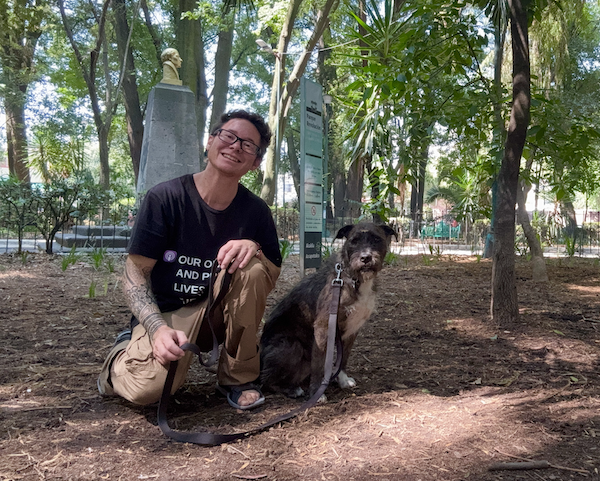
Caden (he/they), CCUI, is a dog trainer, writer and traveler currently based in Mexico and South America. He has been fond of dogs of all sizes, shapes and personalities for as long as he can think—especially the so-called difficult ones. Figuring out how to approach each dog as a unique individual is one of Caden's greatest passions. ...
Registration
Gold
$260
Enrollment limit: 10
- Access to all lectures and homework forums discussion
- Read all posted questions and answers
- Watch all posted videos
- Post general questions to discussion forum
- Submit written assignments
- Post dog specific questions
- Post videos (unlimited)
- Receive instructor feedback
Silver
$130
Enrollment limit: 15
- Access to all lectures and homework forums discussion
- Read all posted questions and answers
- Watch all posted videos
- Post general questions to discussion forum
- Post dog specific questions (video only)
- Post videos (up to 2)
- Receive instructor feedback
Bronze
$65
Enrollment limit: Unlimited
- Access to all lectures and homework forums discussion
- Read all posted questions and answers
- Watch all posted videos