Caring for Your Star Athlete

This class is going to take an in depth look at an integrated approach to your canine athletes physical and emotional wellbeing. This will include: home life, emotions and behavior, competition and training, physical health and wellbeing, and fitness.
Course Details
This class is going to take an in depth look at an integrated approach to your canine athletes physical and emotional wellbeing. This will include: home life, emotions and behavior, competition and training, physical health and wellbeing, and fitness.
Those working in class at gold and silver will be analyzing gaps in their canine athletes' needs, and working on strategies to fill those gaps. We will assess your dog's current strengths and needs, look at relevant science, discuss and apply relevant strategies, and look at some specific fitness exercises that help you and your dog meet your goals. Fitness and related physical care can be made specific to any sport or training activity that a team is working on, so this class would suit any canine team.
Dog’s working at gold or silver may need clearance (i.e. clearance from their main veterinary professional) to be working on fitness training skills. This includes young dogs (12 months or younger), older dogs (8 years or older), or dogs with a significant health or orthopedic issue. Please contact Kelly if you need clarification on this.
Teaching Approach
Kelly will provide multiple lectures at the start of each week, with extensive written explanations and multiple videos illustrating concepts or training practices. Some lectures will have an activity described at the end of the lecture for students to complete to submit in their homework threads, or in the optional Facebook Study group.
All the lectures are released in one go each week, giving students a chance to look through everything and prioritize what is important for them. Week 6 is lighter on practical activities, to give students time to catch up or work through the practical components from previous weeks.
This class will have a Teacher's Assistant (TA) available in the Facebook study group to help the Bronze and Silver students! Directions for joining that Facebook group will be in the classroom after you register.
Syllabus
Week 1
- What is required of today’s canine athletes? Lessons from Human High Performance sports
- Evaluating the Emotional and Physical wellbeing of your Canine Athlete
- Emotions: How can the CER impact your competitions and training?
- Behavior: Looking for signs of stress, or over arousal in your sports dog
- Healthcare: which professionals should you consider using to care for your canine athlete?
- Intro to Canine Fitness
- Baseline fitness measurements
- BONUS - patterns
Week 2
- Stress and arousal management strategies
- Making changes to feelings!
- Training: Clear communication and reinforcement strategies
- Warm up routine
- Foundation fitness skills
- Start and end session cues
Week 3
- Home life: What impact can you make in your dog's sports, from home?
- Key fitness components (Cardio, Flexibility, Strength and Power, Balance and proprioception, and bodywork)
- Principle of specificity for fitness exercises: How to make sure your fitness is working for your sport
- Evaluating nutrition
- Week 3 fitness exercises
- New places, new spaces
Week 4
- Consent: Why and how to use it
- Cardiovascular fitness exercises
- Flexibility exercises
- Supplements, gadgets, gear…. What things do you actually need?
- Competition: Ring preparation, reinforcement strategy and managing emotions
Week 5
- Using patterns and start buttons
- Nails and feet care
- Strength and power exercises
- Balance and proprioception exercises
- Bodywork
- End of ring routines
Week 6
- Structuring workouts
- Planning over a week
- Looking over a year: Planning breaks
- Looking over a year: Preparing and recovering from big events
- Reevaluation and reflection
Prerequisites & Supplies
For fitness specific exercises it will be useful to have:
- A set of cavaletti poles
- A range of platforms
- Target mats
- Some unstable equipment like wobble cushions
However I can give you plenty of ideas on DIY or creative equipment options that suit you, and your dogs.
Sample Lecture
This class will have aspects of Canine Fitness training each week. We’ll work through a wide range of exercises, including how to teach them, equipment options, your starting point in a workout, and how to progress exercises.
Canine Fitness is an area of training that is designed to improve your dog’s functional fitness. It’s also a great way to develop a positive relationship with your canine teammate, and work on clear communication and training practices, as well as improving aspects of your dog's physical condition.
It’s a form of cross training, and has multiple components to improve all aspects of fitness. Think of it as your dog’s gym work!
Equipment
We will use a variety of equipment in class, and I’m happy to discuss equipment substitutions with anyone that has limited access to equipment.
Generally these items will be very useful:
- Long stable non slip platform
- Two smaller stable platforms
- Cones (taller) X2
- Cavaletti poles (8-12)
- Textured silicone target mats
Additional for more advanced dogs:
- Two or more inflatable unstable items like a wobble cushion, FitBone, Flexiness Twin Disc
- Larger non slip square board
- Foot pods
These videos explains the equipment in more detail:
https://www.youtube.com/watch?v=j88hSd2h1y0&feature=youtu.be
Reinforcement markers
We will be covering this in much more detail later in class!
To teach new behaviors we need to reward dogs with something they see reinforcing. If your ‘reward’ is reinforcing, then the frequency that the behavior is performed should increase.
But it’s a little more complex than this, because we also need to consider the conditioned emotional response (CER) to reinforcers. My border collie Evo has the CER of happy fast moving excitement to toy reinforcers. This is not so helpful with fitness training, as we want more calm and thoughtful responses. For this reason I reinforce with food.
I also want to have food reinforcement delivery options that help me teach skills fast! For this reason I start with two food based markers - one (I use yes) for stay in place, I deliver a treat to your face, and one (find it) for a thrown treat that the dog must move out of position to eat.
Having two markers also allows me to make looks of reinforcement that allow high rates of reinforcement along with little down time in between reps. This allows me to teach new skills fast.
For now as we start some fitness work, I find it useful to have two different food markers.
- ‘Yes’ (or your own word!) = stay still, I’ll deliver to your mouth
- ‘Find it’ = move out of position to chase a treat thrown on the ground
Remember marker mechanics can make a large difference. So try to mark the behavior with the verbal, pause, then move a hand to reinforce. Moving the hand too early can itself become a marker and create movement in your dog.
Amethyst reinforcement markers:
Key things that impact form
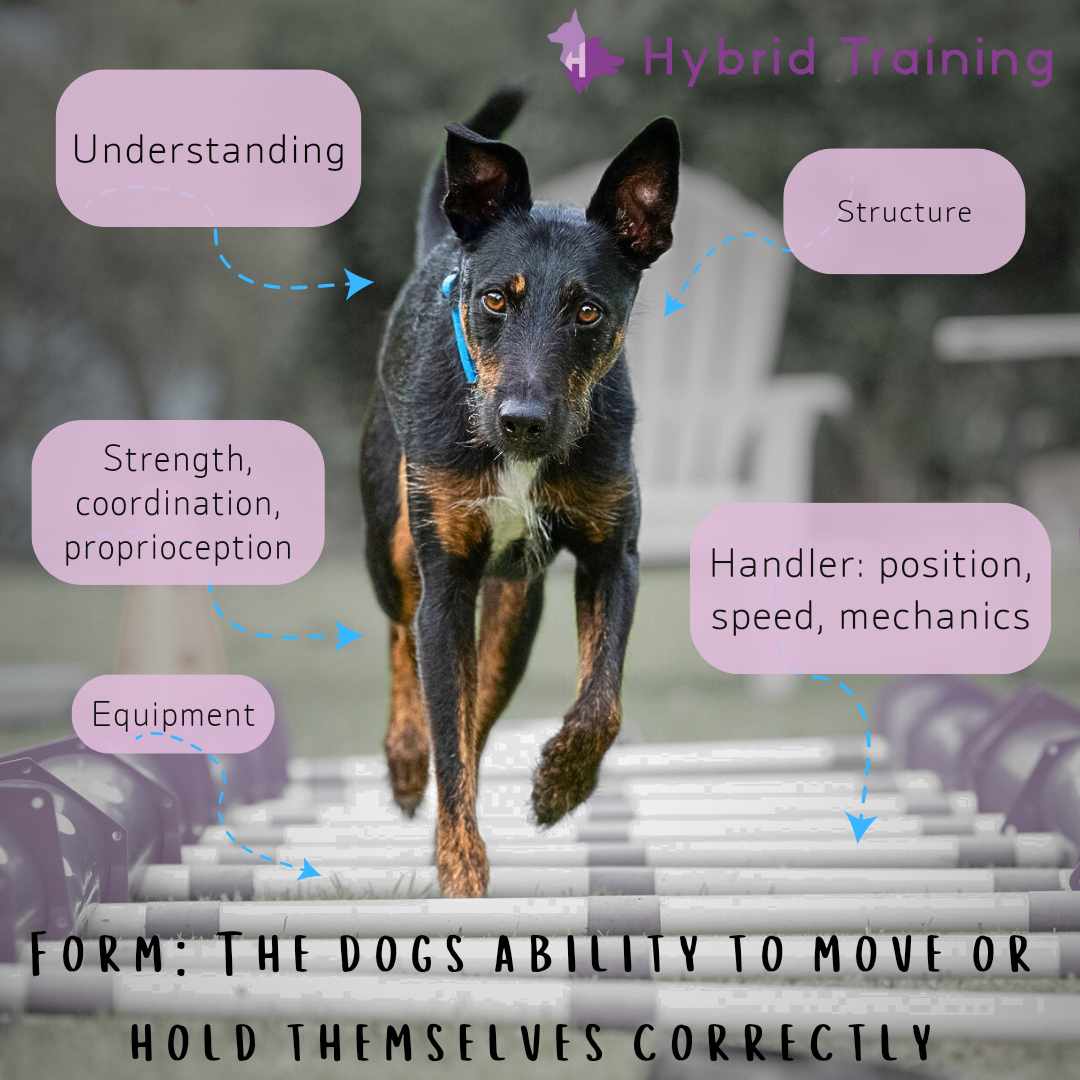
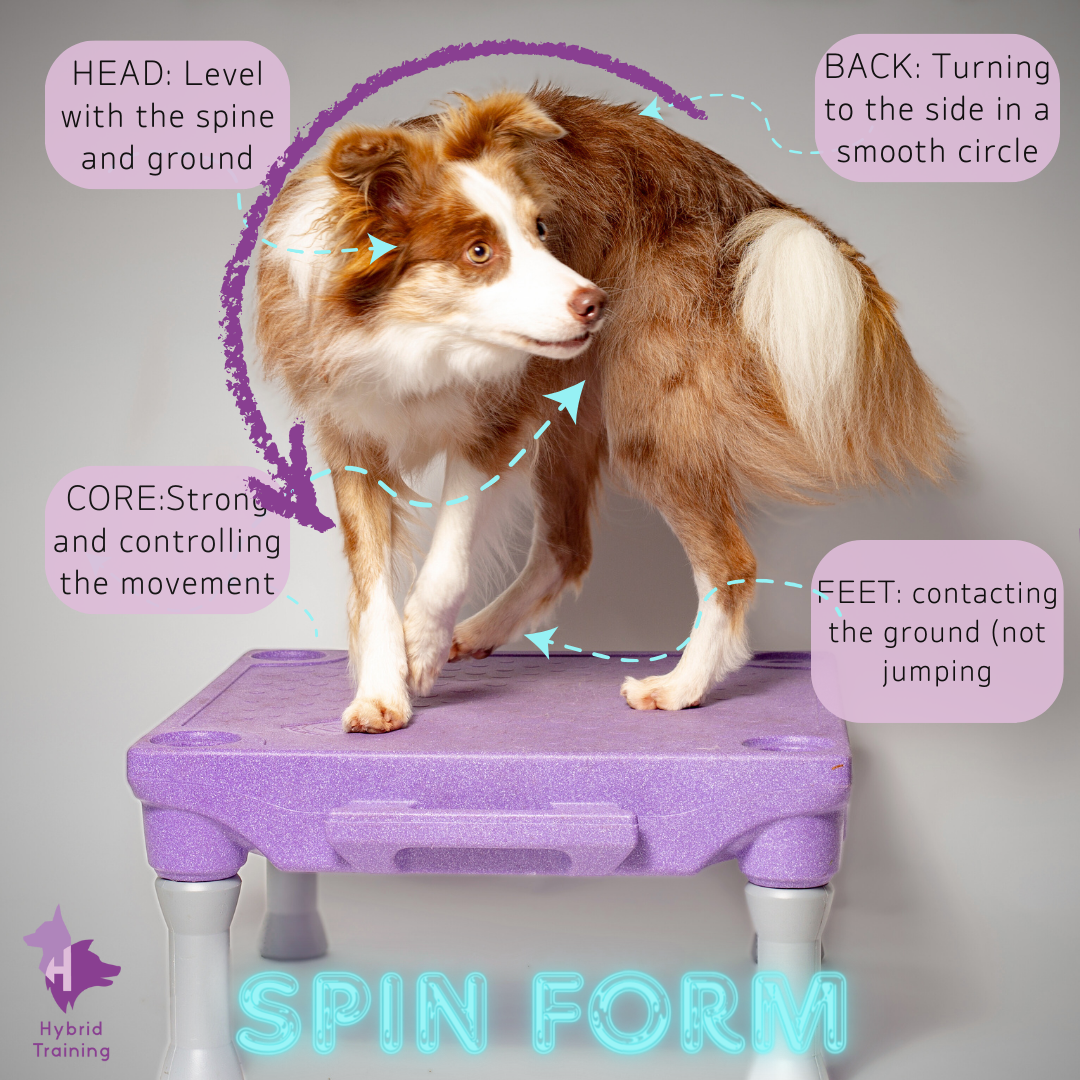
Form is the ability to hold positions correctly, and move correctly. Form can be impacted by a huge number of things, including:
- Understanding
- Arousal
- Current fitness levels
- Injury or illness
- Structure
- Reinforcement mechanics
- Handler position and movement
- Equipment selection and arrangement
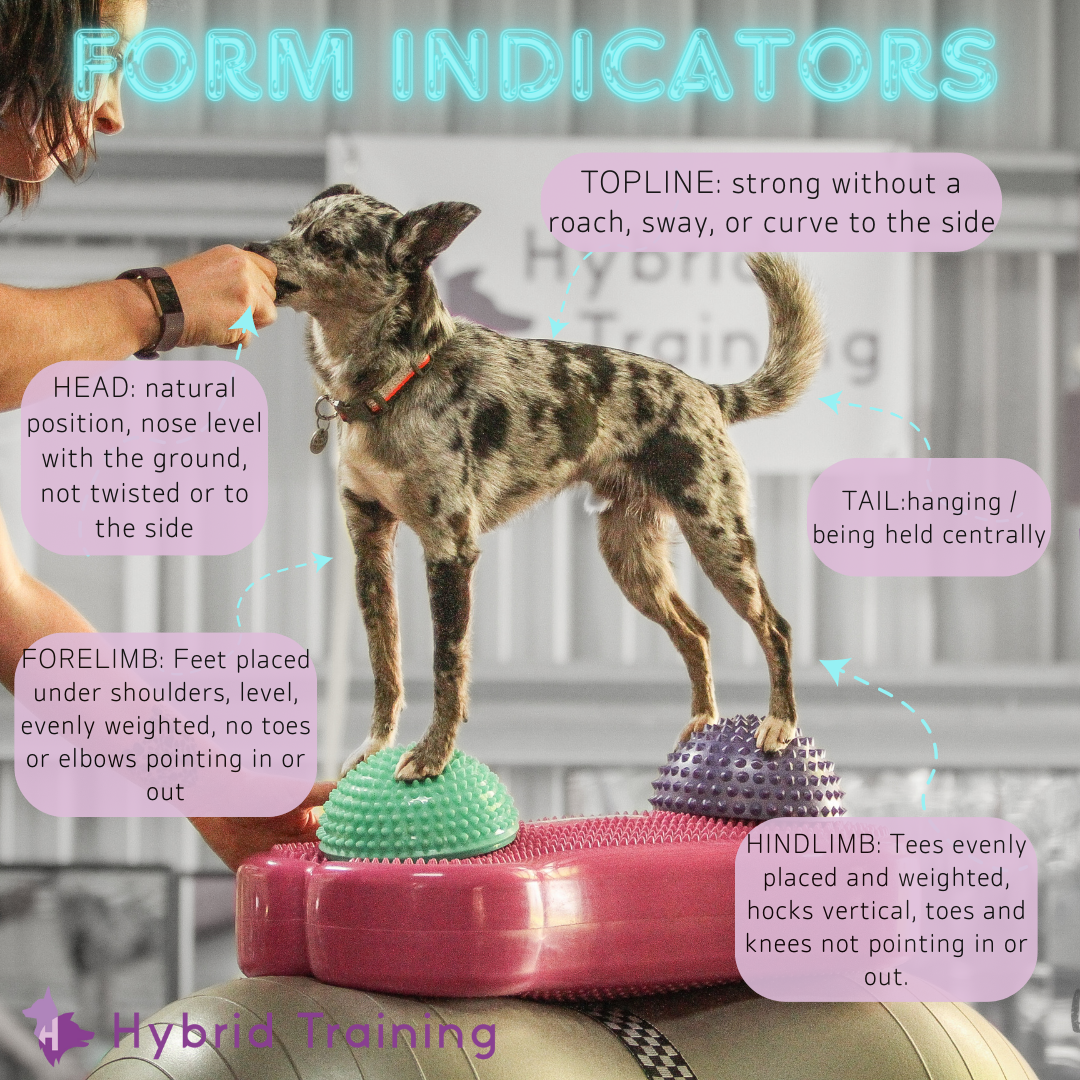
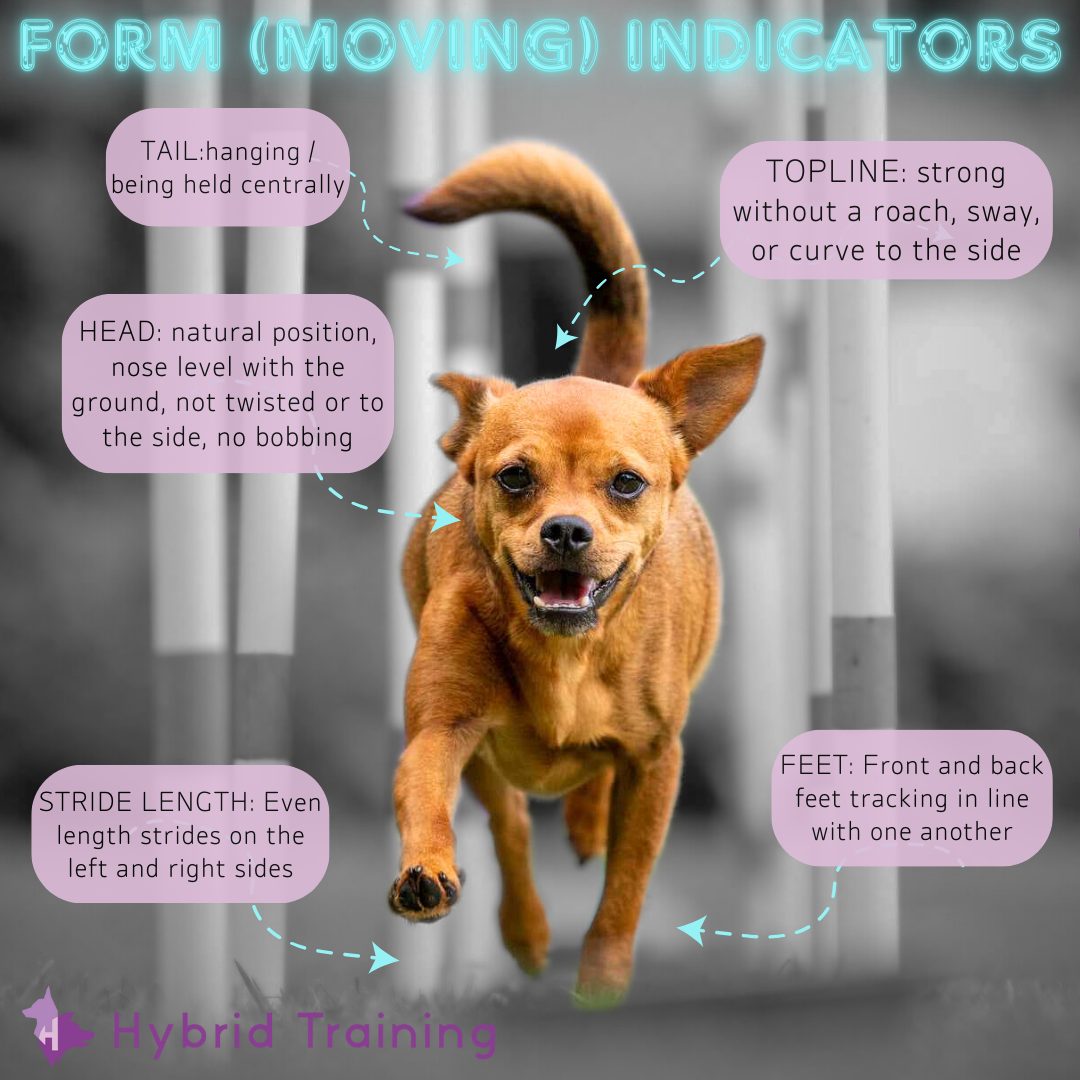
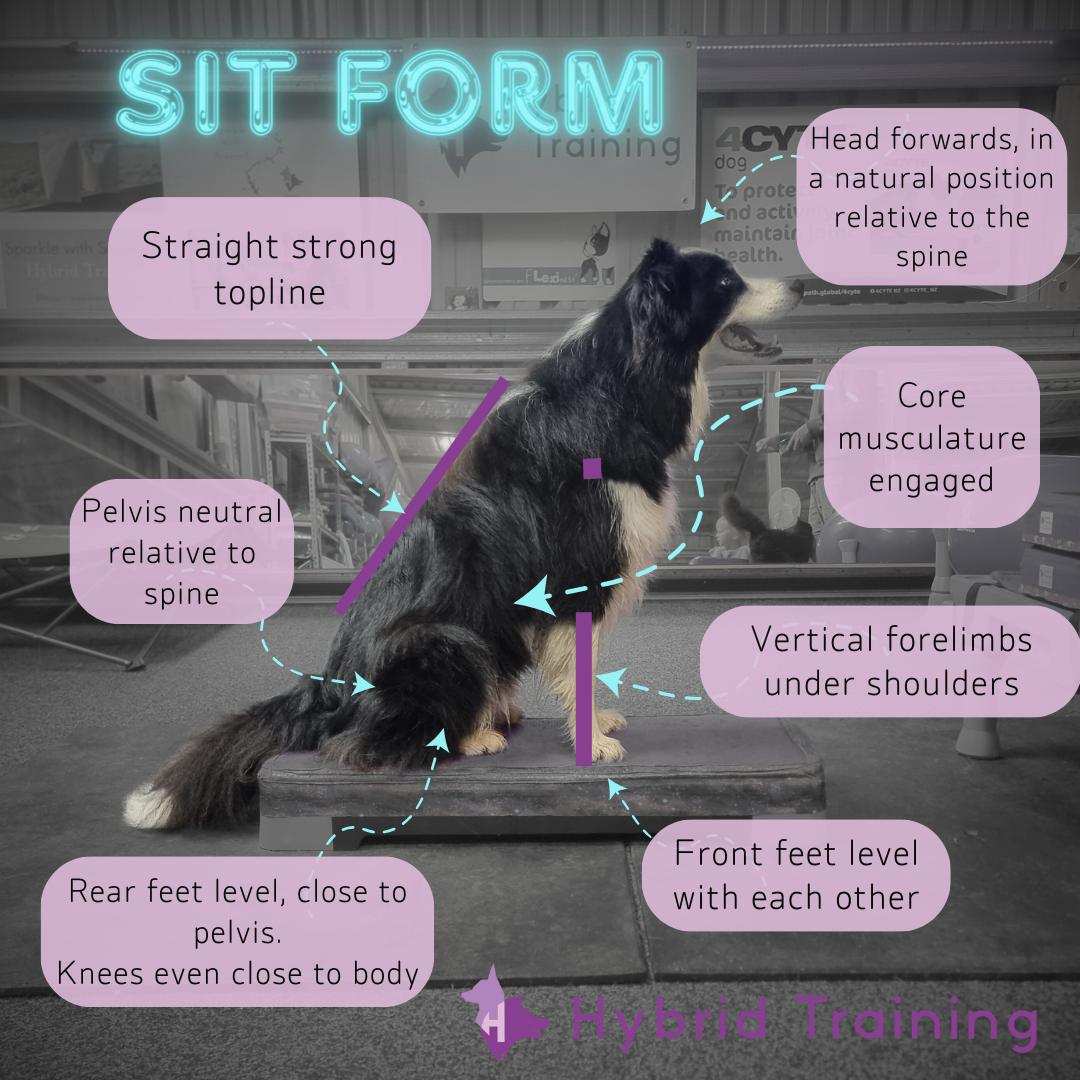
Key things to look at for form:
- Topline (spine)
We want a flat and even topline, or spine. This means there should be no obvious curve from their neck, to the base of the tail. A spine that curves upwards is referred to as roached, and a spine that curves down is a sway back.
- Head position
For fitness we need the dog's head to be in a natural position relative to the topline (spine). Head position can impact multiple other aspects of a dog's form, and often we can alter the dog's head position by changing the handler's position, or the position of the treats (reinforcement).
- Rear feet
Rear feet should be evenly placed relative to one another, hocks vertically straight (this may be behind the dogs pelvis or underneath, depending on their structure), and they should be approximately pelvis width apart. Common issues in rear feet form include tucking the rear feet too far under the dog's body, uneven weighting, toeing inwards or outwards, or the feet too wide or narrow.
- Front feet
Front feet should be evenly placed relative to one another, underneath the dogs shoulders, and evenly weighted. Ideally toes should be pointing forwards, not inwards or outwards. Common issues in front feet form include putting the feet too far outwards from the dog's body, uneven weighting, toeing inwards or outwards, or the feet too wide or narrow.
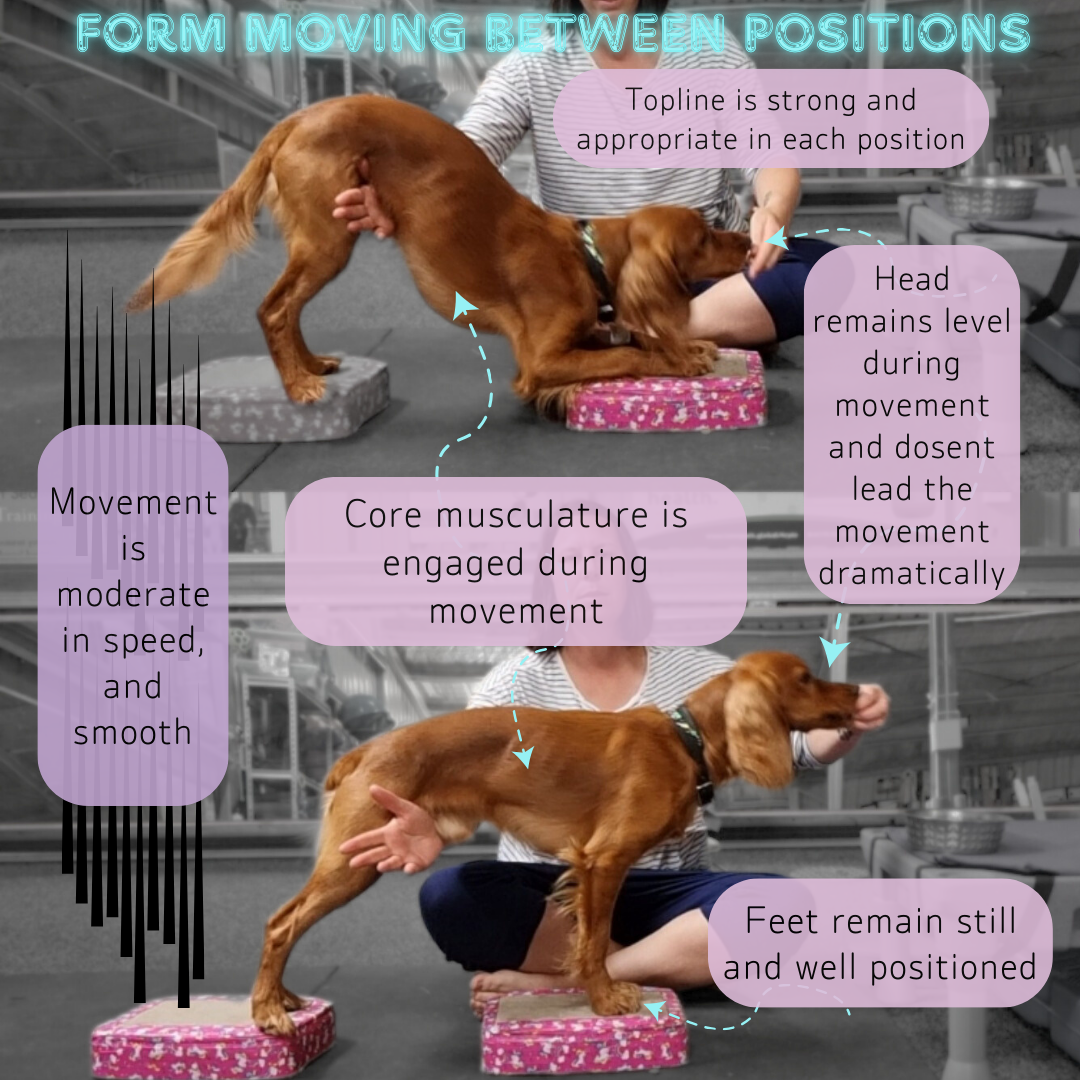
- Sitting and lying down
Additionally to the above aspects of form, we want to consider how the dog is holding the pelvis in a sit or a down. We want an even, and ‘tight’ pelvis and hips. Common issues in form include an uneven pelvis / hips, sloppy positioning to the side, knees and hips both flopping outwards, or a ‘sloppy’ pelvis that rotates backwards.


Stillness Strategies
Sometimes for sports dogs (and handlers!) we’re in a rush to move and find the movement more exciting. But in canine fitness we need dogs to be still in a variety of positions.
For this, we often need to teach the concept of stillness, and then generalize it to different positions. There are three ways (well there is probably more!) that we can try to get stillness with dogs in positions. These have positives, and negatives.
Flori showing three different methods of getting stillness in positions:
- Rapid reinforcement rates: This you can do immediately without training a skill, however the form and movement is not great! Dogs will move their bodies to get the treats, so they aren't super still
- Reverse luring: This skill you have to teach, which can take some time. But it's useful for lots of things (not just fitness) and results in very good stillness in positions. Sometimes form isn't perfect, as some dogs will alter their head position during reverse luring to watch the palm / treats.
- Face targeting (chin rest or nose target). This is again a skill to teach, but we usually get great stillness, and form because we can control the head position. However it can limit the handler position at times as you need to have your hand within reach of the dog's face.
Reverse Luring
I’m a big fan of reverse luring, and use it across a range of training to help my dogs learn the concepts of stillness and duration.
This is a way to get stillness in a dog, when in any position. It's the opposite of luring (where the dog should move, and follow your hand) hence the term 'reverse' luring.
It was initially coined by Laura Waudly, but you may have seen a version of it with Susan Garrett who called it 'it's your choice'. There are also many awesome FDSA instructors who utilize this skill. I learnt this from Sara Brueske.
The main idea is:
- Open hand (with treats on) = stillness
- Closed fist = you're moving! Opps
To teach:
- I like to start with the dog on a platform, as you normally get stillness on this! cue, or wait for your dog to sit (again a position they are used to being still on), when they are still open your fist, and feed WITH YOUR OTHER HAND from the open palm to the dogs mouth.
- If at any time they move just close your fist and wait for stillness.
- If you cue them to change position, or get off the platform, close your fist (as they will be moving).
- It's important that your open / closed fist hand has no movement other than opening and closing. To help this I anchor the elbow of that hand on my knee while sitting.
- When they (and you!) get the hang of it, you can help them generalize by:
- closing the fist
- asking for another position they know like a down
- opening the fist and feeding when they are still
- repeating this off the platform
Amethyst and Tripp learning:
Storm learning:
Glitch applying this concept to a fitness skill:
Bowl placement
In fitness training there is often a benefit to having dogs positioned watching something that isn't you! Sometimes it’s useful to be able to work on the side of your dog, with them still looking ahead.
For this I transfer the concept of reverse luring to an open dish - If my hand is over the dish you’re moving! If it’s off watch the dish. Then I will mark (yes), and pick up a treat from the dish, and feed to mouth.
This allows me to not only work with an open bowl full of treats (useful!) but also control my dog's head position with the bowl placement.
Video - Sage learning to work with an open food dish:
Film a simple reinforcement loop, to check your mechanics. Make sure you have a list of relevant markers, and consider if you need to teach a behavior like reverse luring, a chin rest or a nose target to help with stillness.
Instructors
Kelly Daniel (She/her) is a learning and dog training addict. She has been training and competing with her dogs (of various shapes and forms) for around 15 years ...
Registration
Gold
$260
Enrollment limit: 12
- Access to all lectures and homework forums discussion
- Read all posted questions and answers
- Watch all posted videos
- Post general questions to discussion forum
- Submit written assignments
- Post dog specific questions
- Post videos (unlimited)
- Receive instructor feedback
Registration dates:
March 22, 2026 - April 15, 2026
Silver
$130
Enrollment limit: 25
- Access to all lectures and homework forums discussion
- Read all posted questions and answers
- Watch all posted videos
- Post general questions to discussion forum
- Post dog specific questions (video only)
- Post videos (up to 2)
- Receive instructor feedback
Registration dates:
March 22, 2026 - April 15, 2026
Bronze
$65
Enrollment limit: Unlimited
- Access to all lectures and homework forums discussion
- Read all posted questions and answers
- Watch all posted videos
Registration dates:
March 22, 2026 - April 15, 2026
Scholarship available! Apply here
Why choose us?
We offer a variety of online training solutions designed to help you and your furry friend achieve success

FAQ
Explore the questions we get asked most often and find out everything you need for a smooth experience with us.
Start by clicking on the Course Schedule link at the top of this page. If registration is open, select the course you wish to take from the list and click on that link. From that page, click on the registration link and choose the enrollment level you are interested in. This webpage describes the steps in more detail.
Registration opens on the 22nd of the month preceding the course start date (ie March 22 for courses beginning April 1st) and close on the 15th day of the month the session has started (ie April 15 for courses starting April 1st). You cannot register for 6 week courses outside of this period.
Scholarships are offered to students who do not feel they can afford the full tuition, but who have a sincere interest in expanding their skills as a dog sport trainer. Scholarships are offered in the form of a 50% tuition credit at the Bronze level. To apply, select the Scholarships link from the top menu (under new students) or click this link. We ask that if you are on a scholarship, you limit yourself to one class. There are a maximum of three scholarships per student permitted in a calendar year.
Our testimonials
Don't just take our word for it — see what our clients say about their experience working with us.