BH245 Getting Geeky about Behavior Change
Most importantly, do you want to be one of those people who always seem to know how to adjust their training to optimize results?
Course Details
Are you ready to become a behavior geek?
- Do your ears perk up when someone says "science"?
- Do you find yourself wondering why one training approach works better than another?
- Do you secretly want to be a person who nods knowingly when someone talks about the Matching Law?
Most importantly, do you want to be one of those people who always seem to know how to adjust their training to optimize results?
If so, this is the course for you!
In Getting Geeky about Behavior Change, Irith Bloom will take you on a journey through applied behavor science -- with a healthy dose of theory so you understand why you are doing what you are doing, and can apply that knowledge to whatever training task you are facing.
Topics covered will range from the basics of learning theory to the many higher-level factors that make all the difference when you're faced with a challenging training or behavior issue.
Since this is the first time this course is being offered, the syllabus is not yet set in stone (so to speak), but here are just a few of the topics we'll delve into:
- Learning Theory (both basic and advanced)
- Cueing (in all its glory -- and believe me, it is glorious 🙂)
- Habits and Routines (and how they can be useful... or not)
That's just a taste of what Irith has in mind. Gold and Silver students will have input into which other topics are covered.
While there will be set exercises to practice in this course, Gold students will also be encouraged to try things that may not be in the formal lectures, depending on what their goals are. That means Bronze and Silver students will get to see the process of selecting the right tecniques in action!
So join Irith to get geeky and learn why we do what we do, as well as how to do it all even better.
NOTE: Irith was first described as a geek by others when it was a bit less cool, and has always been proud to wear that badge. 😁
One more note: As mentioned above, this is a first-time course, and the course content will be determined in part by the Gold and Silver students, so definitely consider snagging at least a Silver spot!
Teaching Approach
Lectures will be released once a week, but each week will include more than one mini-lecture. You can watch all the week’s mini-lectures at once or space them out, as you prefer. A brief summary of the week's lectures will also be provided each week.
NOTE: Most lectures will be provided in video format as well as in a transcript.
I will be checking the class forums at least twice each day, unless an announcement is made otherwise. I will endeavor to address posts within about 18 hours, but it may occasionally take a little longer.
NOTE: As mentioned earlier, student input will help shape what the course covers to some extent, so Silver and Gold students are encouraged to use the forums to share their ideas and thoughts.
Syllabus
Prework
- Ensure your pet is healthy. Always do a vet check before implementing any new training!
- Students don't need to have a training or behavior goal to join this class; it's fine if you just want to be geeky. 😉
- Planning on signing up for a Gold spot but not sure if a goal you are considering for class is suitable? Reach out to Irith by e-mail at Trainer@TheSophisticatedDog.com to ask!
Topics Covered (subject to change)
*Note that most of the topics listed will be addressed in more than one way during the course, since so many of these topics intersect in multiple ways. Interacting with these topics in different ways will both help you internalize what you learn and deepen your understanding of each of the topics.
- Associative Learning
- Classical Conditioning
- Operant Conditioning
- Non-Associative Learning
- Habituation
- Sensitization
- Stress and Learning
- Impacts of Arousal
- Optimal Performance
- Cues and Other Signals
- Cues
- Commands
- Learned Irrelevance
- Surprising Reasons for "Misbehavior"
- Goal-Directed Behavior
- Habitual Behavior
- Innate Behavior
- Motivation
- Satiation
- The Matching Law
- David Premack's "Principle"
- Practical exercises will help students explore the theoretical ideas presented.
- Gold Students will also be provided with additional skills options as appropriate for their specific goals -- a sort of "choose your own adventure" experience.
- Each week's topics will build on prior topics, so it is strongly recommended that students follow along with the lectures even if they don't have time to do the practical exercises each week.
Prerequisites & Supplies
Sample Lecture
NOTE: This sample lecture is an example of a geeky "knowledge" lecture. There will also be more "practical" lectures with suggested exercises students can use to explore these geeky concepts!
NOTE: Want to watch a video of this lecture instead of reading it? Click on the video above!
Hi everyone! I'm Irith Bloom, and this is Fenzi Dog Sports Academy BH245: Getting Geeky About Behavior Change.
Non-Associative Learning
In this lecture I'm going to be talking about non-associative learning, which is a type of learning that some of you may not be familiar with.
Associative Learning
Before going into the topic of non-associative learning, I want to quickly review associative learning, which is a type of learning that many of you are likely familiar with, even if you don't necessarily know this specific term.
Classical Conditioning and Operant Conditioning
Associative learning comes in two form, classical conditioning and operant conditioning.
Both classical and operant conditioning are covered in greater depth in other lectures, so I'm not going to go into them in depth in this lecture, but I am going to delve a bit into why they are both forms of associative learning.
In associative learning, associations are being made, and they may be positive or negative associations.
As the name implies, associative learning has to do with making associations.
Negative Associations
Some of those associations may be negative.
For example, if every time an animal sees a motorcycle, they receive a shock, they may come to associate motorcycles with shock and have a negative association and likely negative emotions associated with motorcycles.
Similarly, if every time an animal jumps up they receive a shock, they're likely to associate the behavior of jumping up with the consequence of getting a shock and they will form a negative association. And it is possible that the shock will punish the jumping up and you'll see less jumping up.
The first example of the motorcycle and and the shock is a classical conditioning association. The two stimuli happen at about the same time and the animal forms an association between them.
The second example of the animal jumping up in the shock is an operant conditioning association where the animal associates its behavior with a consequence.
Positive Associations
Not all associations are negative, of course. Animals also form positive associations.
For example, if when the animal saw motorcycles, they got a treat each time, they would start to associate the presence of motorcycles with treats and they would have positive associations with motorcycles and likely have a positive emotional responseto the presence of a motorcycle.
Similarly, if every time the animal goes to a mat they get a treat, they're going to associate going to a mat with getting a treat. The behavior of going to a mat gets associated with the positive consequence of getting a treat and they will have a positive association with the behavior of going to the mat.
Back to Non-Associative Learning
That brings us to non-associative learning.
The key point with non-associative learning is that there aren't clear associations between between different stimuli.
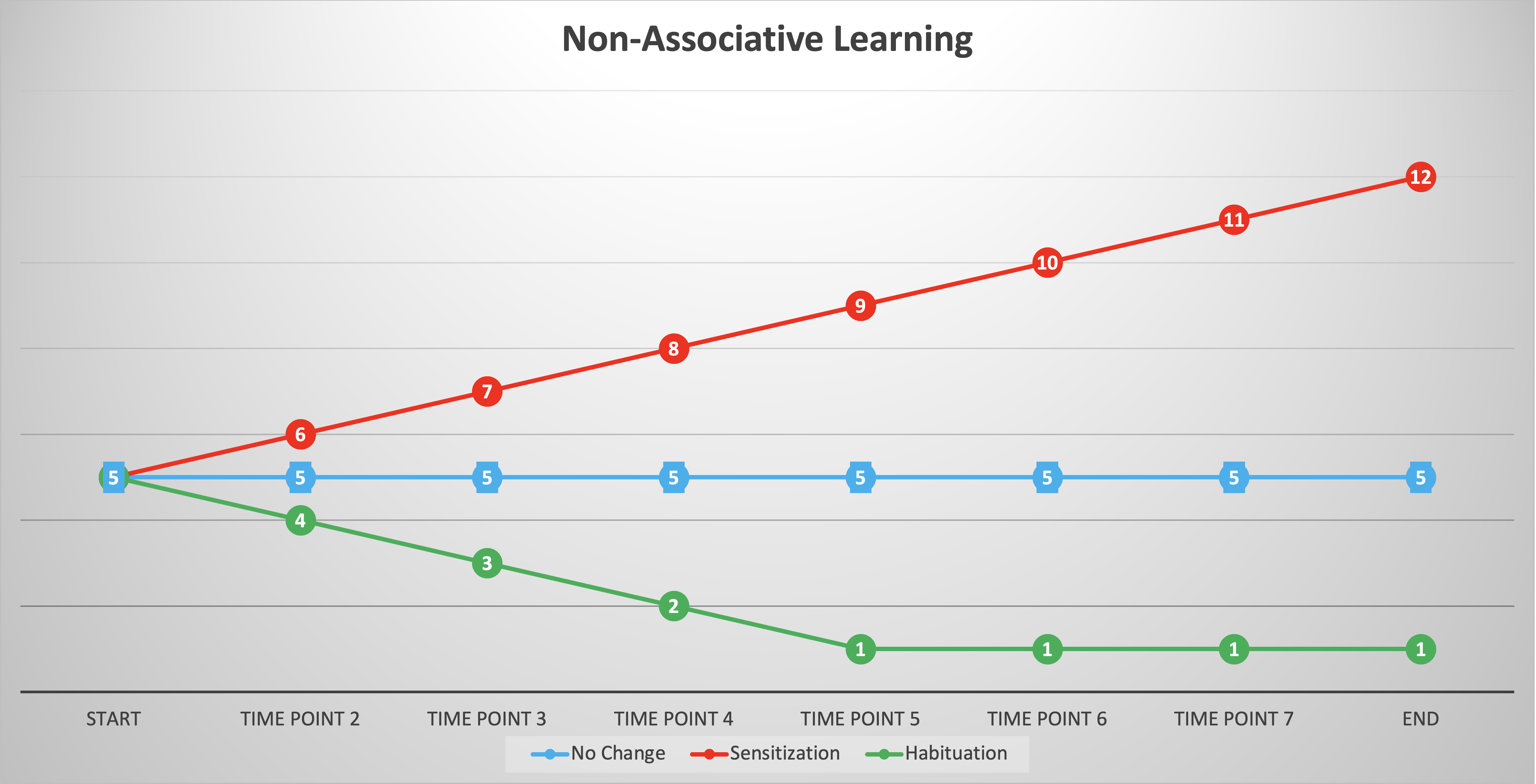
Non-associative Learning is divided into two main categories. The two forms of non-associative learning are known as sensitization and habituation. I'm going to use this little graphic of non-associative learning to help explain habituation and sensitization.
Example Scenario for This Discussion
An example may help make things clearer. The example I will use is that of an animal that is inside a home with the windows closed and the shades down when fireworks are happening in the neighborhood. So there are loud boom booms happening, but there's nothing else. There's no smell of fireworks. There are no flashes of light. It's just these sudden loud noises.
Three Possibilities: No Change, Sensitization, Habituation
There are three things that can happen in a situation like that where there are these loud booms happening.
Let's start by assuming that the first time the boom happens, the animal has some kind of startle response, which is a very normal and typical thing to happen. And let's say for the sake of our conversation here that their startle response is a 5 on some random scale.
No Change
One of the things that can happen is that there is absolutely no change in the animal's behavior as the fireworks go on.
The first time they heard a firework, their startle was at a level five. Next time, same level five. Next time, same level five. And the time after that, still the same level five. That's the blue line that you see in the middle, where you see it's 5 5-5-5-5 -- all the way across the line stays flat. And there is no change in the animal's behavior. That is one possibility.
Sensitization
Another possibility is that sensitization will occur.
Sensitization in this image is shown in the red line, which is the line that goes from being at a 5 in the lower left side to being at a 12 in the upper right side.
With sensitization, what you would observe as you watch the animal is that when that first firework goes off, they have that same startle we mentioned before, at level five. But then when the next firework goes off, their startle is even bigger -- we could call it a level six. Then the one after that, the startle goes up to a level seven, and the next one after that to a level eight, and so on and so on until the animal is having massive reactions to the fireworks that are much bigger than they were when they heard the first Firework.
Essentially, what's happening is the animal is becoming more sensitized to the fireworks, more sensitive to them. They're reacting more and more.
Again, this is called sensitization.
Sensitization is something that in general we really don't want to see a lot of, because it means the animal overreacts more and more to the stimulus.
Habituation
There's one other possibility in this situation in terms of non-associative learning, which is what we call habituation.
Habituation is the green line that goes down as you follow the chart. So on the right side of the chart, it's down at a level one.
With habituation, as you observe the animal, what you would see is that the first startle at the fireworks was still a level five. But then when the next firework goes off, their startle is smaller and milder -- it's just a level four. And after that it's a level three. And then it's a level two. And after a few fireworks, the animal is just going about their day almost as if they don't even hear the fireworks going on.
That is called habituation, and that is something that we do like to see.
Quick Recap
Again, there are three options here.
- There is the possibility that the fireworks go off, and there's no change in the startle response of the animal as the fireworks go on.
- There's the possibility that as the fireworks go on, the animal's response will get bigger and bigger. We call that sensitization.
- There's the possibility that as the fireworks go off, the animal's response will get to be less and less and they will become completely nonchalant about the fireworks. We call that habituation.
Reminder: Habituation and Sensitization are Non-Associative Learning
The reason we call both habituation and sensitization non-associative learning is because there's no consistent pairing or association of one stimulus with another that is responsible for changing the animal's response. The sound of the firework is happening, and then what happens afterwards is random.
For classical conditioning associations to form, we need a consistent pairing -- the firework happens and then something good happens, or the firework happens and then something bad happens.
But that's not happening here, because what happens after the fireworks is random. There's no consistent pairing.
Similarly, there's no reinforcement or punishment. Nobody is observing the animal's startle response and then feeding them a treat to make that startle response bigger. Nobody is observing the animal's startle response and then shocking the animal to punish that startle and make the startle response smaller.
And yet the behavior is changing. It's getting more extreme or less extreme, even though there is no reinforcement or punishment. So no operant conditioning associations are happening, but the behavior is changing anyway.
Learning is taking place, but it's not taking place as a result of associations between the stimulus of the firework and some other stimulus.
Why Does This Matter?
If non-associative learning is "just happening" and basically outside our control -- there's no pairing of stimuli like in classical conditioning, there are no punishers and reinforcers like in operant conditioning, the behavior is just changing through non-associative learning -- why should we care?
Non-Associative Learning Can Affect Associative Learning
The reason we should care is that non-associative learning can affect associative learning.
In other words, the things that the animal has learned through non-associative learning can make our training more or less effective and can change the associations that are formed when we're doing classical conditioning and operant conditioning.
For example, with an animal who is sensitized to fireworks during fireworks season, that animal is going to be more stressed. Stress affects an animal's ability to learn. That means that whatever classical conditioning or operant conditioning we are trying to do with that animal is likely to be less effective during fireworks season.
Another consideration is that there is a possibility that non-associative learning is happening even while we are consciously working on associative learning processes -- when we're doing classical conditioning, when we're doing operant conditioning. I'm sure you can imagine how if an animal is sensitizing or habituating to something while we are doing training, there could be times when when that would interfere with our goals.
It Pays to Be Aware of Non-Associative Learning
The bottom line is that we should at the very least be aware of what kind of non-associative learning is happening with our animal. There may also be times when we want to take steps to help prevent the wrong kind of non-associative learning.
Quick Overview of Types of Learning
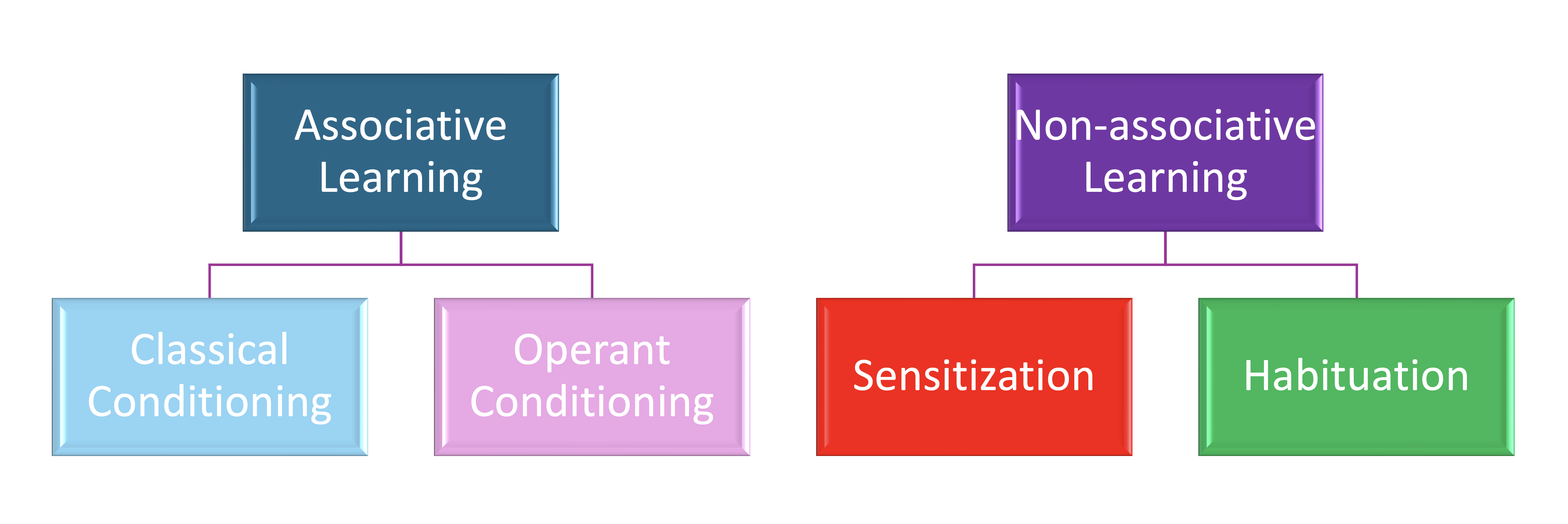
Let's quickly review the types of learning that we've discussed in this lecture.
We've talked about associative learning, which is marked in blue above, and non-associative learning, which is marked in purple.
In associative learning, we have classical conditioning and operant conditioning, and in non-associative learning, we have sensitization and habituation.
This lecture has focused on the right side of this slide -- on the non-associative learning. Other lectures go into associative learning in greater depth.
Key Takeaways
Here are the key takeaways from this lecture:
- Not all learning involves associations between stimuli.
- Non-associative learning can be very powerful.
- Non-associative learning interacts with associative learning and can have an impact on associative learning.
- Paying attention to non-associative learning is important for us.
- It's a good idea to pay attention to what's happening with non-associative learning in daily life.
- Also pay attention to whether non-associative learning is happening during training, which is always a possibility.
- Awareness of non-associative learning is key to success, no matter what you want to do with an animal.
Next Steps
Gold and Silver Students
- Think about when non-associative learning is happening for your animal.
- Which type of non-associative learning is it?
- Is it habituation?
- Is it sensitization?
- Which type of non-associative learning is it?
- Share your thoughts and ideas.
- Post questions and videos
Bronze Students
- Follow along.
- Try this at home with the animals you live with.
Thank you so much! I'll see you next time!
Instructors
Irith Bloom finds joy in helping people teach with kindness while developing choice-rich environments for their companion animals. ...
Registration
Gold
$260
Enrollment limit: 10
- Access to all lectures and homework forums discussion
- Read all posted questions and answers
- Watch all posted videos
- Post general questions to discussion forum
- Submit written assignments
- Post dog specific questions
- Post videos (unlimited)
- Receive instructor feedback
Registration dates:
September 22, 2026 - October 15, 2026
Silver
$130
Enrollment limit: 25
- Access to all lectures and homework forums discussion
- Read all posted questions and answers
- Watch all posted videos
- Post general questions to discussion forum
- Post dog specific questions (video only)
- Post videos (up to 2)
- Receive instructor feedback
Registration dates:
September 22, 2026 - October 15, 2026
Bronze
$65
Enrollment limit: Unlimited
- Access to all lectures and homework forums discussion
- Read all posted questions and answers
- Watch all posted videos
Registration dates:
September 22, 2026 - October 15, 2026
Why choose us?
We offer a variety of online training solutions designed to help you and your furry friend achieve success

FAQ
Explore the questions we get asked most often and find out everything you need for a smooth experience with us.
Start by clicking on the Course Schedule link at the top of this page. If registration is open, select the course you wish to take from the list and click on that link. From that page, click on the registration link and choose the enrollment level you are interested in. This webpage describes the steps in more detail.
Registration opens on the 22nd of the month preceding the course start date (ie March 22 for courses beginning April 1st) and close on the 15th day of the month the session has started (ie April 15 for courses starting April 1st). You cannot register for 6 week courses outside of this period.
Scholarships are offered to students who do not feel they can afford the full tuition, but who have a sincere interest in expanding their skills as a dog sport trainer. Scholarships are offered in the form of a 50% tuition credit at the Bronze level. To apply, select the Scholarships link from the top menu (under new students) or click this link. We ask that if you are on a scholarship, you limit yourself to one class. There are a maximum of three scholarships per student permitted in a calendar year.
Our testimonials
Don't just take our word for it — see what our clients say about their experience working with us.