Foundation Jumping for All Sports

If you want to do dog sports then you’ll want a variety of foundation skills. One of the most critical of these skills is teaching your dog to jump!
If you hold your breath while your dog throws themselves at obstacles then this class is for you. Correct jumping is quiet, fluid, and powerful! Good jumpers create confident handlers who can focus on their side of the equation - providing cues and information while the dog does their job - move through the jumping exercises with confidence and ease!
Whether your sport is obedience, agility, flyball or doggy disc, your dog must learn how to use their body correctly so that they are confident in themselves and learn to love their doggy sports!
If you want your dog to be the best jumper possible, join Loretta Mueller and teach your dog the mechanics of jumping!
This class is a foundation level class that will get your absolute beginner off on the right foot. This class is also appropriate for dogs that are already struggling, either showing less than stellar form or experiencing issues with their confidence.
Class will cover all types of jumps from single bars to triples to broad jumps, though each individual’s rate of progress will vary. Take your time and teach this foundation skill with excellence!
Loretta will not use a single “method” to teach jumping; rather the class will introduce a variety of techniques to get the best out of each team.
Course Details
If you want to do dog sports then you’ll want a variety of foundation skills. One of the most critical of these skills is teaching your dog to jump!
If you hold your breath while your dog throws themselves at obstacles then this class is for you. Correct jumping is quiet, fluid, and powerful! Good jumpers create confident handlers who can focus on their side of the equation - providing cues and information while the dog does their job - move through the jumping exercises with confidence and ease!
Whether your sport is obedience, agility, flyball or doggy disc, your dog must learn how to use their body correctly so that they are confident in themselves and learn to love their doggy sports!
If you want your dog to be the best jumper possible, join Loretta Mueller and teach your dog the mechanics of jumping!
This class is a foundation level class that will get your absolute beginner off on the right foot. This class is also appropriate for dogs that are already struggling, either showing less than stellar form or experiencing issues with their confidence.
Class will cover all types of jumps from single bars to triples to broad jumps, though each individual’s rate of progress will vary. Take your time and teach this foundation skill with excellence! The goal of this class is to give you the tools to create a talented, education jumper even after the 6 weeks are over!
Loretta will not use a single “method” to teach jumping; rather the class will introduce a variety of techniques to get the best out of each team.
Dogs should be one year of age or older to gain maximum benefit from this course.
Teaching Approach
Lectures are released on the first day of each week. They are a combination of written lectures and video demonstrations.
You do not have to run or move quickly for the lessons in this class., as the exercises are mostly gridwork, so even if you have mobility issues, you can do the exercises. If you need changes to the exercises or modifications, please post on your Gold thread.
Feedback is provided using a timestamp, and description of what I am talking about in the video submission. An example of this is below:
0:33 can you see here, when he took jump 2, his shoulders snapped back? That tells me he is rushing that line.
0:17 that dropped bar was because she slipped and her take off was changed. Just disregard that, it was just an accident.
This class will have a Teacher's Assistant (TA) available in the Facebook study group to help the bronze and silver students! Directions for joining that Facebook group will be in the classroom after you register.
Syllabus
Week 1: What is good jumping? What are we looking for from our dogs? What inhibits good jumping? Determining your dogs jumping style. And Value Building for jumping. Does my dog have a jumping problem?
Week 2: Jump Grid introduction/Handler Involvement/How to Use/What we are looking for! Introducing the Broad Jump and Spread Jumps (doubles and triples) and Panel Jumps
Week 3: Collection: What it is! What it is NOT! How do we get it?? Grid work AND one jump work. Tailored to YOUR dogs needs!
Week 4: Extension: What it is! What it is NOT! How do we get it?? Grid work AND one jump work. Tailored to YOUR dogs needs!!
Week 5: Transitioning between Extension and Collection--Drills for dogs to help develop fluid jumping at top speed!
Week 6: Committment/Proofing Jumping Form---on all jumps, spreads, broad jump, single jumps, panel jumps etc. Problem solving jumping issues!
Prerequisites & Supplies
Dog should be at least one year of age for maximum benefit however puppies can benefit from this work, I suggest using jump bumps instead of jump bars.
Jumps: Whichever ones you want to work on! The ones we will be using as examples are: Single jump, Broad jump, Double jump, Triple Jump, Panel Jump. The goal is to create a dog that can adjust at speed! Ideally 4 single jumps is a great start, the more jumps you have, and the more room, the more we can do! So lets shoot for 4 jumps :)
You will need a "space" for this class...there will be one jump drills, but we will also be doing grid work, which will involve several jumps in an row. Adjustments can be made depending on your space, but realize the more space you have, the more you can do.
IF YOU HAVE very specific issues (aka my dog hates the broad jump) then you will need that particular jump to work on.
Sample Lecture
The goals of this 6 week session is to lay the groundwork for your dogs to have wonderful jumping form which includes:
Proper form
Proper execution of the jumps
Ability to Guage and adjust at high rates of speed
Proofing jumping
Problem Solving Skills
What are we looking for?
If I were to describe what a dog jumping looks like, what would be your description?
Fluid?
Smooth?
Controlled?
Effortless?
Appropriate for the particular jump?
Here are two pictures of dogs. Notice now relaxed they look, focused on their jobs. This is what we are looking for :)
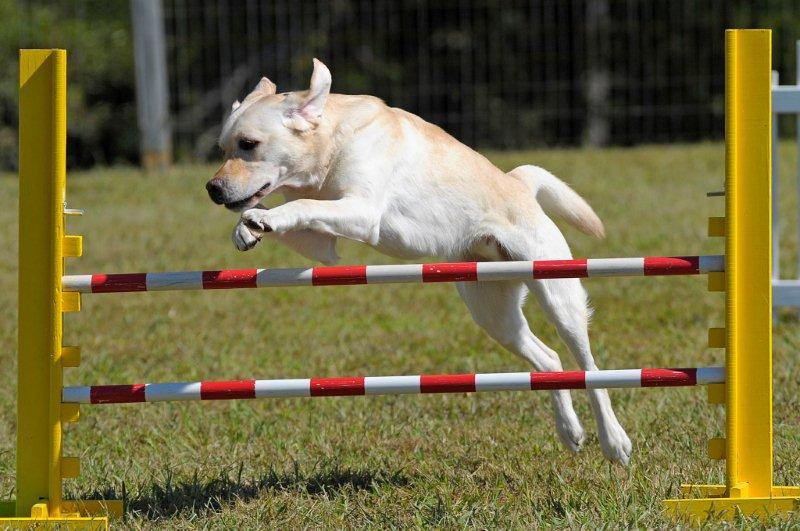
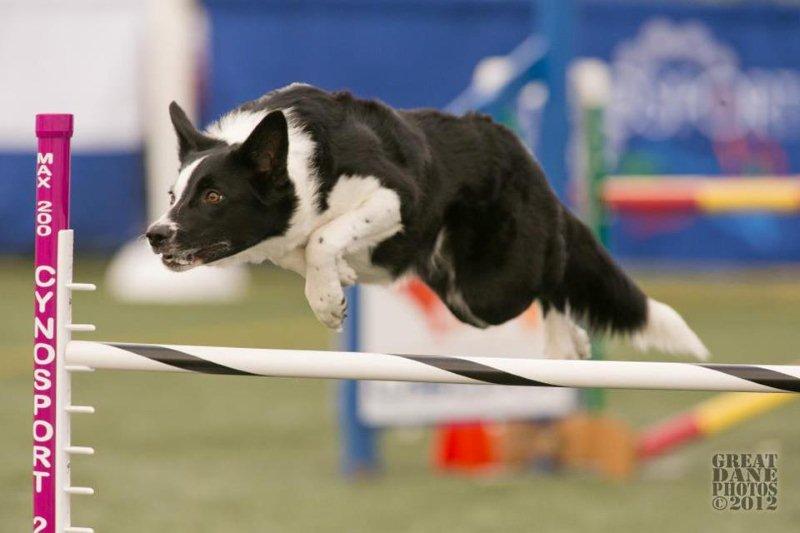
Jumping is a very precise activity, but for the sake of working on our understanding, we will divide jumping into two types: Extension and Collection.
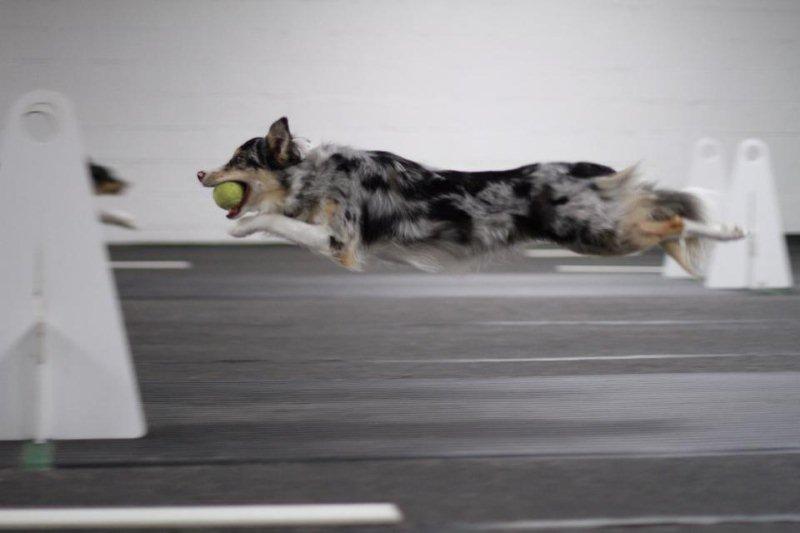
Extension: Head flat, back flat, front legs tucked or extended, back legs either tucked or extended (depends on dogs build) more on the front end of the body than the rear end. This is used for speed, straight lines etc. There should be NO SIGN OF SLOWING DOWN. Here are several examples of dogs jumping in extension:
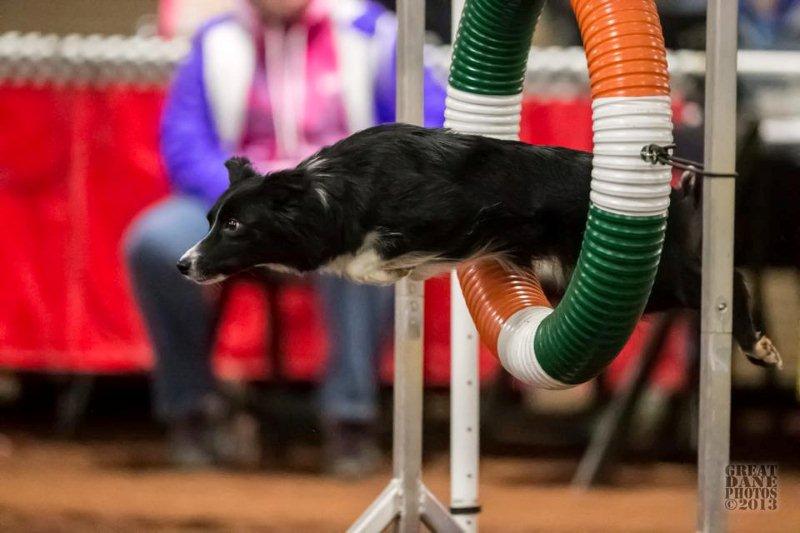
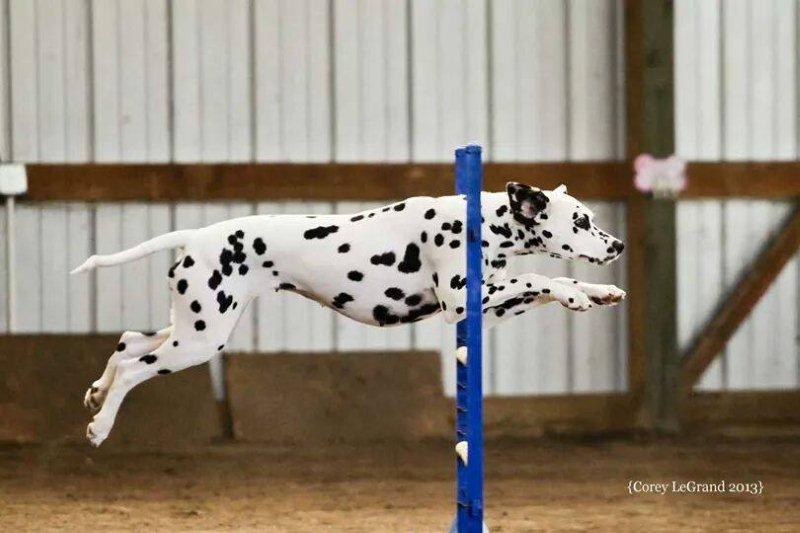
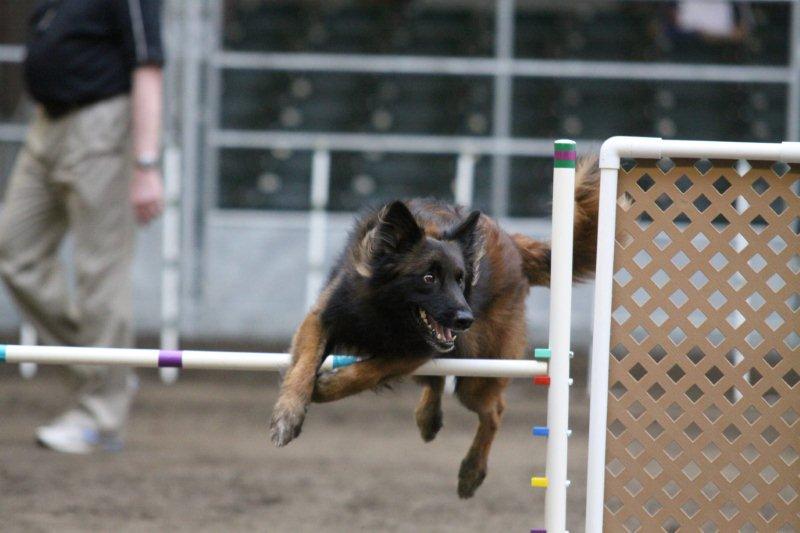
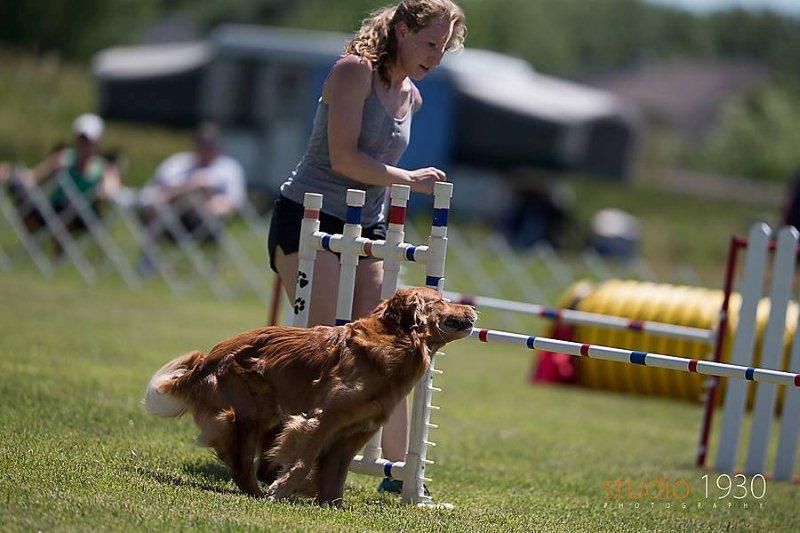
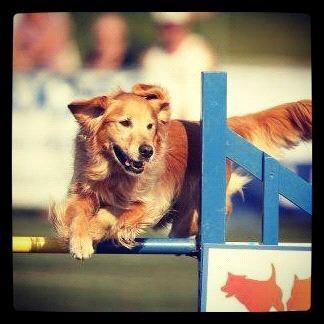
Collection: Head low, back rounded, front legs tucked, back legs tucked moreso than extended (but again depends on dogs build and at what point in the jump the dog is at). The weight will be more in the rear of the dog as they are taking off. This is used for turns. You will see a DEFINED CHANGE OF SPEED going into the jump! Here are examples of several dogs jumping in collection:
Great Dane Photos
The dogs must be able to transition between extension and collection and vice versa. Here is an example of a dog properly transitioning from extension to collection.
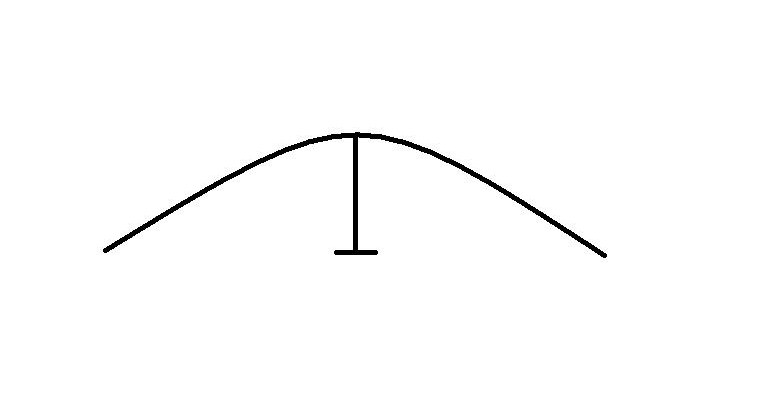
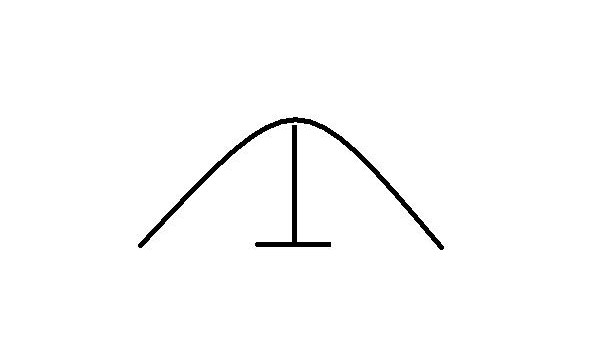
As you can see there is a very different trajectory for jumping between Extension and Collection. What is Trajectory? By definition it is: The path followed by an object moving under the action of given forces.
So the trajectory of extension is flatter and the take off and landing point is further from the base of the jump. As shown here:
And the trajectory of collection is more rounded with the take off and landing closer to the base of the jump. As shown here:
Instructors
Loretta Mueller (she/her) has been involved in agility since 2003 with her first rescue dog, Ace. Since then she has been involved in a variety of dog training activities including USBCHA herding, competitive obedience, rally obedience, and service dog training. In 2007, Loretta...
Registration
Gold
$260
Enrollment limit: 12
- Access to all lectures and homework forums discussion
- Read all posted questions and answers
- Watch all posted videos
- Post general questions to discussion forum
- Submit written assignments
- Post dog specific questions
- Post videos (unlimited)
- Receive instructor feedback
Registration dates:
January 22, 2026 - February 15, 2026
Silver
$130
Enrollment limit: 25
- Access to all lectures and homework forums discussion
- Read all posted questions and answers
- Watch all posted videos
- Post general questions to discussion forum
- Post dog specific questions (video only)
- Post videos (up to 2)
- Receive instructor feedback
Registration dates:
January 22, 2026 - February 15, 2026
Bronze
$65
Enrollment limit: Unlimited
- Access to all lectures and homework forums discussion
- Read all posted questions and answers
- Watch all posted videos
Registration dates:
January 22, 2026 - February 15, 2026
Scholarship available! Apply here
Why choose us?
We offer a variety of online training solutions designed to help you and your furry friend achieve success

FAQ
Explore the questions we get asked most often and find out everything you need for a smooth experience with us.
Start by clicking on the Course Schedule link at the top of this page. If registration is open, select the course you wish to take from the list and click on that link. From that page, click on the registration link and choose the enrollment level you are interested in. This webpage describes the steps in more detail.
Registration opens on the 22nd of the month preceding the course start date (ie March 22 for courses beginning April 1st) and close on the 15th day of the month the session has started (ie April 15 for courses starting April 1st). You cannot register for 6 week courses outside of this period.
Scholarships are offered to students who do not feel they can afford the full tuition, but who have a sincere interest in expanding their skills as a dog sport trainer. Scholarships are offered in the form of a 50% tuition credit at the Bronze level. To apply, select the Scholarships link from the top menu (under new students) or click this link. We ask that if you are on a scholarship, you limit yourself to one class. There are a maximum of three scholarships per student permitted in a calendar year.
Our testimonials
Don't just take our word for it — see what our clients say about their experience working with us.